General Chemistry
My Course
Learn
Exam Prep
AI Tutor
Study Guides
Textbook Solutions
Flashcards
Explore
My Course
Learn
Exam Prep
AI Tutor
Study Guides
Textbook Solutions
Flashcards
Explore
Back
Balancing Chemical Equations quiz #3
You can tap to flip the card.
Explain why chemical equations have to be balanced.
You can tap to
flip the card.
👆
Explain why chemical equations have to be balanced.
To obey the law of conservation of mass and ensure accurate stoichiometric calculations.
Track progress
Control buttons has been changed to "navigation" mode.
1/18
Terms in this set (18)
Hide definitions
Explain why chemical equations have to be balanced.
To obey the law of conservation of mass and ensure accurate stoichiometric calculations.
Balance the chemical equation: N2O3 → N2 + O2.
2N2O3 → 2N2 + 3O2 is the balanced equation.
BaCl2 + MgSO4 → ? What are the products?
BaSO4 + MgCl2 are the products; the balanced equation is BaCl2 + MgSO4 → BaSO4 + MgCl2.
Write the balanced chemical equation for the reaction shown.
Write the equation so that the number of atoms of each element is equal on both sides.
H2O2(aq) + ClO2(aq) → ClO2−(aq) + O2(g). Is this equation balanced?
No, it is not balanced; balancing is required.
Write a balanced overall reaction from these unbalanced half-reactions.
Combine the half-reactions and balance both atoms and charges.
2Fe3+(aq) + 3Sn(s) → 2Fe(s) + 3Sn2+(aq). Is this equation balanced?
Yes, this equation is balanced.
The reaction between elemental phosphorus P4(s) and O2(g) to make P4O10(s): Write the balanced equation.
P4 + 5O2 → P4O10 is the balanced equation.
Balance the equation in acidic conditions. Phases are optional.
Balance both atoms and charges, adding H+ and H2O as needed.
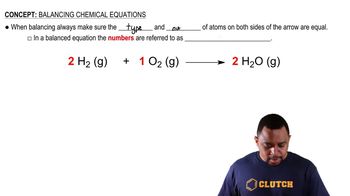
To balance a chemical equation, it may be necessary to adjust the
Coefficients in front of the chemical formulas.
Select the coefficients necessary to balance each equation. Choose a coefficient for every compound.
Choose coefficients so that the number of atoms of each element is equal on both sides.
2KClO3(s) → 2KCl(s) + 3O2(g). Is this equation balanced?
Yes, this equation is balanced.
Enter a balanced equation for the dissolution of CaCO3.
CaCO3(s) → Ca2+(aq) + CO3^2−(aq)
BaI2(aq) + AgNO3(aq) → What are the products?
Ba(NO3)2(aq) + 2AgI(s) are the products.
2CH4(g) → C2H6(g) + H2(g). Is this equation balanced?
No, it is not balanced; balancing is required.
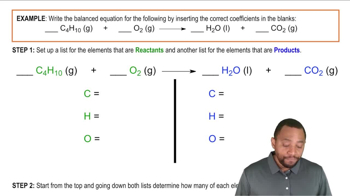
C3H8 + O2 = CO2 + H2O. What is the balanced equation?
C3H8 + 5O2 → 3CO2 + 4H2O is the balanced equation.
Balance the equations by inserting coefficients as needed.
Insert coefficients so that the number of atoms of each element is equal on both sides.
2SO2(g) + O2(g) → 2SO3(g). Is this equation balanced?
Yes, this equation is balanced.