Skip to main content
General Chemistry
My Course
Learn
Exam Prep
AI Tutor
Study Guides
Textbook Solutions
Flashcards
Explore
Try the app
My Course
Learn
Exam Prep
AI Tutor
Study Guides
Textbook Solutions
Flashcards
Explore
Try the app
Back
Band of Stability: Alpha Decay & Nuclear Fission quiz
You can tap to flip the card.
What is the band or valley of stability in nuclear chemistry?
You can tap to flip the card.
👆
What is the band or valley of stability in nuclear chemistry?
It is the region on a neutron-to-proton plot where isotopes are stable; isotopes outside this band are unstable and radioactive.
Track progress
Control buttons has been changed to "navigation" mode.
1/15
Related flashcards
Related practice
Recommended videos
Band of Stability: Alpha Decay & Nuclear Fission definitions
Band of Stability: Alpha Decay & Nuclear Fission
15 Terms
Band of Stability: Alpha Decay & Nuclear Fission
21. Nuclear Chemistry
2 problems
Topic
Jules
21. Nuclear Chemistry - Part 1 of 3
5 topics
7 problems
Chapter
Jules
21. Nuclear Chemistry - Part 2 of 3
5 topics
9 problems
Chapter
Jules
21. Nuclear Chemistry - Part 3 of 3
4 topics
10 problems
Chapter
Jules
Guided course
01:46
Band of Stability: Alpha Decay
1486
views
8
rank
Guided course
03:29
Band of Stability: Nuclear Fission
1396
views
6
rank
Guided course
01:16
Band of Stability: Alpha Decay Example
1334
views
5
rank
Terms in this set (15)
Hide definitions
What is the band or valley of stability in nuclear chemistry?
It is the region on a neutron-to-proton plot where isotopes are stable; isotopes outside this band are unstable and radioactive.
Why are isotopes outside the band of stability considered radioactive?
They have an imbalance in their neutron and proton numbers, making them unstable and prone to decay.
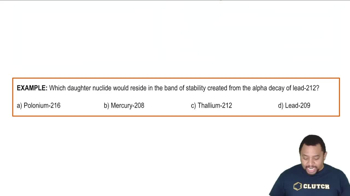
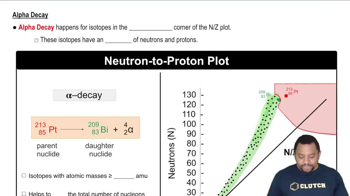
What is the main purpose of alpha decay for unstable isotopes?
Alpha decay reduces the number of protons and neutrons, helping the isotope move closer to the band of stability.
Which isotopes typically undergo alpha decay?
Isotopes with atomic masses equal to or greater than 210 amu, especially those with excess neutrons and protons.
What particle is emitted during alpha decay?
An alpha particle, which consists of 2 protons and 2 neutrons, is emitted.
What happens to the atomic number and mass number during alpha decay?
Both the atomic number and mass number decrease as the isotope loses protons and neutrons.
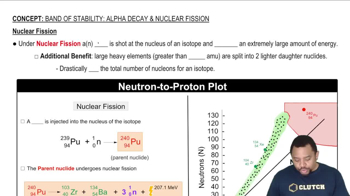
What is nuclear fission?
Nuclear fission is the process of splitting a heavy nucleus into lighter, more stable nuclides by bombarding it with a neutron.
What is the main objective of nuclear fission in practical applications?
The main objective is to extract a large amount of energy from the process.
What initiates nuclear fission in a heavy isotope like plutonium-239?
A neutron is injected into the nucleus, making it unstable and causing it to split.
What are the products of nuclear fission of plutonium-240?
The products are zirconium-103, barium-134, three neutrons, and a large amount of energy.
What is a chain reaction in nuclear fission?
A chain reaction occurs when the neutrons produced in fission cause further fission reactions in other nuclei, perpetuating the process.
How does nuclear fission help isotopes reach stability?
It splits heavy, unstable isotopes into lighter, more stable daughter nuclides within the band of stability.
What additional benefit does nuclear fission provide besides energy release?
It produces stable daughter nuclides that fall within the band of stability.
What is the significance of the neutron-to-proton plot in understanding nuclear stability?
It visually shows which isotopes are stable and which are likely to undergo radioactive decay to reach stability.
Name two other processes, besides alpha decay and nuclear fission, that help isotopes reach stability.
Beta decay and electron capture are two other processes that can help isotopes move toward the band of stability.
 BackBack
 01:46
01:46