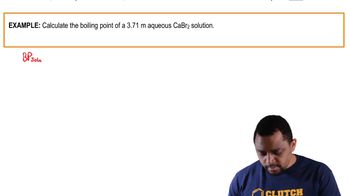
How does adding a solute to a solvent affect its boiling and freezing points?
Adding a solute to a solvent raises the boiling point (boiling point elevation) and lowers the freezing point (freezing point depression) of the solvent.
Which substance has the lowest boiling point among water, ethanol, benzene, and chloroform?
Ethanol has the lowest boiling point among water, ethanol, benzene, and chloroform.
Which 1 m aqueous solution has the highest boiling point: NaCl, glucose, CaCl2, or pure water?
1 m CaCl2 solution is predicted to have the highest boiling point because it has the highest Van't Hoff factor, resulting in greater boiling point elevation.
Which has the highest boiling point: pure water, 1 m NaCl solution, or 1 m glucose solution?
1 m NaCl solution has the highest boiling point due to the boiling point elevation caused by the dissolved ions.
Which substance most likely has the highest boiling point: pure water, 1 m sucrose solution, or 1 m K2SO4 solution?
1 m K2SO4 solution most likely has the highest boiling point because it produces more ions, increasing the boiling point elevation.
Which type of solution has the highest boiling point: pure solvent, solution with non-ionic solute, or solution with ionic solute?
A solution with an ionic solute would have the highest boiling point due to a higher Van't Hoff factor.
Which of these solutes raises the boiling point of water the most: NaCl, glucose, or CaCl2?
CaCl2 raises the boiling point of water the most because it dissociates into three ions, giving it the highest Van't Hoff factor.
How does antifreeze affect the boiling point in a car's radiator?
Antifreeze increases the boiling point of the coolant in a car's radiator, helping prevent overheating.
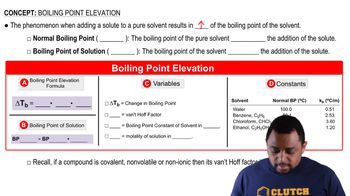
What is the formula for boiling point elevation?
ΔTb = i × Kb × m, where ΔTb is the boiling point elevation, i is the Van't Hoff factor, Kb is the boiling point elevation constant, and m is the molality.
Which solution has the highest boiling point: 2 m NaCl, 2 m glucose, or pure water?
2 m NaCl solution would have the highest boiling point due to the greater number of dissolved ions.
Which has the highest boiling point: pure water, 1 m Na2SO4 solution, or 1 m urea solution?
1 m Na2SO4 solution is expected to have the highest boiling point because it produces more ions, increasing boiling point elevation.
Which has the highest boiling point: pure water, 1 m NaCl solution, or 1 m KCl solution?
1 m NaCl and 1 m KCl solutions have higher boiling points than pure water, but their boiling points are similar due to similar Van't Hoff factors.
Which has the higher boiling point: pure water or 1 m NaCl solution?
1 m NaCl solution has a higher boiling point than pure water due to boiling point elevation.
What is the boiling point of gold?
The boiling point of gold is 2,856°C.
Which ion contributes most to elevating the boiling point of H2O among Na+, Ca2+, and Al3+?
Al3+ will contribute most to elevating the boiling point if present in a compound that dissociates into more ions, increasing the Van't Hoff factor.
Which has the higher boiling point, HF or HCl? Why?
HF has a higher boiling point than HCl due to strong hydrogen bonding between HF molecules.
Arrange the following compounds by boiling point: pure water, 1 m NaCl solution, 1 m CaCl2 solution.
1 m CaCl2 solution > 1 m NaCl solution > pure water (from highest to lowest boiling point).
Calculate the boiling point of a 3.60 m aqueous sucrose solution. (Kb for water = 0.51°C/m, normal boiling point = 100°C, i for sucrose = 1)
 Back
Back
 03:05
03:05