Back

Bronsted-Lowry Acids and Bases quiz

Control buttons has been changed to "navigation" mode.
1/15
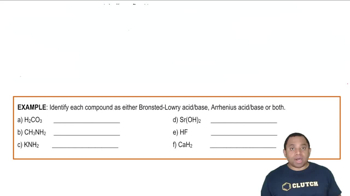
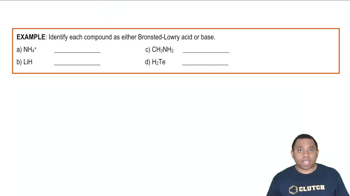
  • What is the Brønsted-Lowry definition of an acid?

    A Brønsted-Lowry acid is a proton (H+) donor.
  • What is the Brønsted-Lowry definition of a base?

    A Brønsted-Lowry base is a proton (H+) acceptor.
  • How does the Brønsted-Lowry definition differ from the Arrhenius definition?

    The Brønsted-Lowry definition is broader, including any proton donor or acceptor, not just substances that produce H+ or OH− in water.
  • What ion is formed when an acid donates a proton to water?

    The hydronium ion (H3O+) is formed.
  • What happens to a base when it accepts a proton in a Brønsted-Lowry reaction?

    It becomes a conjugate acid.
  • What is a conjugate acid-base pair?

    A conjugate acid-base pair consists of two species that differ by one proton (H+).
  • What is the conjugate base of hydrobromic acid (HBr) after it donates a proton?

    The conjugate base is Br−.
  • What is the conjugate acid formed when ammonia (NH3) accepts a proton?

    The conjugate acid is ammonium ion (NH4+).
  • Are all Arrhenius acids also Brønsted-Lowry acids?

    Yes, all Arrhenius acids are also Brønsted-Lowry acids.
  • Are all Brønsted-Lowry bases also Arrhenius bases?

    No, only bases that produce OH− in water are Arrhenius bases; some Brønsted-Lowry bases do not.
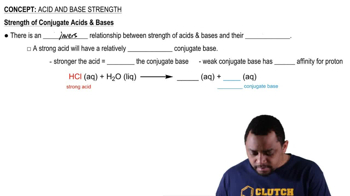
  • What is the relationship between the strength of an acid and its conjugate base?

    There is an inverse relationship: strong acids have weak conjugate bases, and weak acids have relatively strong conjugate bases.
  • What happens to the direction of equilibrium in a reaction involving a weak acid?

    The equilibrium favors the reactants, meaning most of the acid remains un-ionized.
  • How do you form a conjugate acid from a base?

    Add an H+ (proton) to the base.
  • How do you form a conjugate base from an acid?

    Remove an H+ (proton) from the acid.
  • What does it mean if a conjugate base has a low affinity for protons?

    It means the conjugate base is weak and does not readily accept protons.