Back

Carboxylic Acid Reactions quiz

Control buttons has been changed to "navigation" mode.
1/15
  • What type of reaction occurs when a carboxylic acid reacts with a base?

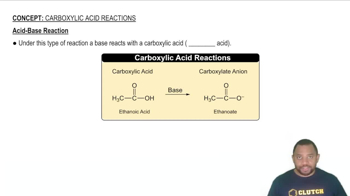
    An acid-base reaction occurs, where the base removes a proton (H+) from the carboxylic acid.
  • What is formed when a base removes a proton from a carboxylic acid?

    The conjugate base of the carboxylic acid, called a carboxylate anion, is formed.
  • What is the name change that occurs when ethanoic acid forms its conjugate base?

    The name changes from 'ethanoic acid' to 'ethanoate.'
  • How can you identify a carboxylic acid from its name?

    Carboxylic acids have names ending in 'oic acid.'
  • What does the ending 'oate' signify in a compound's name?

    It signifies the compound is a carboxylate anion, the conjugate base of a carboxylic acid.
  • Are carboxylic acids considered strong or weak acids?

    Carboxylic acids are classified as weak acids.
  • What is the general result of a carboxylic acid reacting with a base?

    The result is the removal of an H+ ion, forming a carboxylate anion.
  • What is the conjugate base of ethanoic acid called?

    The conjugate base of ethanoic acid is called ethanoate.
  • What role does the base play in a carboxylic acid reaction?

    The base removes a proton (H+) from the carboxylic acid.
  • What is the functional group present in carboxylic acids?

    Carboxylic acids contain the carboxyl group (-COOH).
  • What is the charge on the carboxylate anion formed after deprotonation?

    The carboxylate anion carries a negative charge.
  • Why is the acid-base reaction of carboxylic acids important in organic chemistry?

    It demonstrates the reactivity and behavior of carboxylic acids in different chemical environments.
  • What happens to the hydrogen atom in the carboxyl group during a reaction with a base?

    The hydrogen atom (as H+) is removed by the base.
  • What is the significance of the name change from 'oic acid' to 'oate'?

    It indicates the transformation from the acid to its conjugate base (anion) form.
  • What is an example of a carboxylic acid and its corresponding carboxylate anion?

    Ethanoic acid is a carboxylic acid, and ethanoate is its corresponding carboxylate anion.