Back

Chemical Bonds quiz

Control buttons has been changed to "navigation" mode.
1/15
  • What is the main driving force behind the formation of chemical bonds between atoms?

    Atoms form chemical bonds to achieve a filled outer electron shell, similar to noble gases.
  • How do metals and nonmetals typically achieve a noble gas configuration in ionic bonding?

    Metals lose electrons to become cations, while nonmetals gain electrons to become anions, resulting in both achieving noble gas configurations.
  • What type of chemical bond involves the transfer of electrons from one atom to another?

    Ionic bonding involves the transfer of electrons from a metal to a nonmetal.
  • What is the result of the electron transfer in ionic bonding?

    The result is the formation of oppositely charged ions (cations and anions) that attract each other to form an ionic compound.
  • Why is the formation of an ionic bond considered exothermic?

    It is exothermic because energy is released when the oppositely charged ions attract and combine.
  • What is an example of a compound formed by ionic bonding?

    Sodium chloride (NaCl) is formed by the ionic bonding of sodium and chlorine.
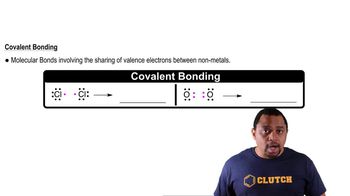
  • How do nonmetals achieve a filled outer shell in covalent bonding?

    Nonmetals share valence electrons with each other to fill their outer shells.
  • What is the difference between a single and a double covalent bond?

    A single bond involves sharing one pair of electrons, while a double bond involves sharing two pairs of electrons.
  • Which elements are involved in the formation of a single covalent bond in the example given?

    Two chlorine atoms form a single covalent bond by sharing one electron each.
  • How do two oxygen atoms achieve noble gas configuration through bonding?

    They share two pairs of electrons, forming a double bond, to fill their outer shells like neon.
  • What type of chemical bond involves the sharing of electrons between nonmetals?

    Covalent bonding involves the sharing of electrons between nonmetals.
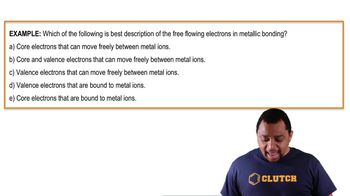
  • What is metallic bonding and what does it involve?

    Metallic bonding is the attraction between free-floating valence electrons and positively charged metal ions.
  • Why are metals malleable and good conductors of electricity?

    Because their valence electrons are free to move throughout the metal, allowing for malleability and conductivity.
  • How are the electrons in metallic bonding different from those in ionic or covalent bonds?

    In metallic bonding, electrons are not confined to individual atoms but move freely among the metal ions.
  • What property of metals is explained by the presence of free-moving electrons in metallic bonding?

    The presence of free-moving electrons explains metals' malleability and electrical conductivity.