Pearson+ LogoPearson+ Logo

Chemical Properties quiz #7 Flashcards

Chemical Properties quiz #7
Control buttons has been changed to "navigation" mode.
1/40
  • What are the primary elements that make up Earth's atmosphere?

    Nitrogen and oxygen are the primary elements in Earth's atmosphere.
  • Water is an example of a compound. Which of the following is the best description of all compounds?

    Compounds are substances formed by chemically combining two or more elements.
  • Which of the following is evidence of a chemical reaction?

    Formation of a gas is evidence of a chemical reaction.
  • Which greenhouse gas is most abundant?

    Carbon dioxide is the most abundant greenhouse gas.
  • What two elements must be present in a silicate?

    Silicon and oxygen must be present in a silicate.
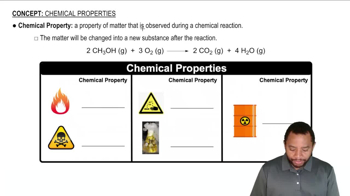
  • Which of these warnings refers to a chemical property of the material?

    Warning: Flammable refers to a chemical property.
  • Which statement is a chemical property of copper?

    Copper reacts with oxygen to form copper oxide.
  • Venus' atmosphere is primarily made up of what gas?

    Venus' atmosphere is primarily made up of carbon dioxide.
  • Which property can be used to identify a pure substance as an element?

    An element cannot be broken down by chemical means.
  • The air we breathe consists mostly of what gas?

    The air we breathe consists mostly of nitrogen.
  • When mixed with water, what happens to sodium chloride?

    Sodium chloride dissolves in water, forming ions.
  • Which molecule in the atmosphere is responsible for blocking harmful UV radiation from the sun?

    Ozone blocks harmful UV radiation from the sun.
  • Which of the following is a chemical property of water?

    Water reacts with sodium to produce hydrogen gas.
  • Which is a property of (nonpolar) covalent compounds?

    Nonpolar covalent compounds do not conduct electricity.
  • What happens when 2 or more elements chemically combine?

    They form a compound with new properties.
  • What are the commonly accepted indicators of a chemical reaction? Select all that apply.

    Color change, gas production, and formation of a precipitate are indicators.
  • Why is water considered a polar molecule?

    Water is polar because it has an uneven distribution of charge due to its bent shape and electronegative oxygen atom.
  • Why is water a polar molecule?

    Water is polar because oxygen is more electronegative than hydrogen, creating partial charges.
  • Which of the following is the best example of a heat conductor?

    Copper is the best example of a heat conductor.
  • What acts like fingerprints that identify atoms and molecules?

    Chemical properties act like fingerprints to identify atoms and molecules.
  • What may occur if water is added to a burning liquid that is less dense than water?

    The burning liquid may float on water and continue to burn.
  • What makes water polar?

    Water is polar due to its bent shape and the electronegativity difference between oxygen and hydrogen.
  • Why is helium instead of hydrogen used in blimps?

    Helium is used because it is nonflammable and safer than hydrogen.
  • Which type of solution has the ability to corrode metals?

    Acidic solutions can corrode metals.
  • Why is copper a good conductor of electricity?

    Copper has mobile electrons that allow it to conduct electricity.
  • Which phrase most accurately describes a chemical change?

    A chemical change produces new substances with different properties.
  • Hard water is high in calcium and magnesium while soft water is high in what?

    Soft water is high in sodium.
  • What is the difference between the solute and solvent? Give an example.

    The solute is dissolved in the solvent; for example, salt (solute) in water (solvent).
  • Ambient air contains what percentage of oxygen?

    Ambient air contains about 21% oxygen.
  • Which is an example of a chemical reaction?

    Rusting of iron is an example of a chemical reaction.
  • How many atoms of nitrogen are in the chemical formula Ni(NO3)2?

    There are 2 nitrogen atoms in Ni(NO3)2.
  • Which statement correctly describes glucose (C6H12O6)?

    Glucose is a compound made of carbon, hydrogen, and oxygen.
  • Which statement best explains why radon and krypton do not bond easily with other elements?

    Radon and krypton have full valence electron shells, making them unreactive.
  • Which best describes a compound such as sodium chloride?

    Sodium chloride is an ionic compound formed from sodium and chlorine.
  • How many atoms of nitrogen are in the chemical formula Ni(NO3)2?

    There are 2 nitrogen atoms in Ni(NO3)2.
  • Which statement describes a property that is unique to metalloids?

    Metalloids can conduct electricity better than nonmetals but not as well as metals.
  • What property of dishwashing liquid (detergent) makes it useful to wash grease from pans?

    Detergents are polar and can dissolve grease, which is nonpolar.
  • Where are chlorofluorocarbons found? a. coolants b. the atmosphere c. solvents d. all of the above

    Chlorofluorocarbons are found in all of the above: coolants, the atmosphere, and solvents.
  • Which mineral resource is used to make batteries? graphite, gypsum, talc, clay

    Graphite is used to make batteries.
  • Why doesn't oil mix with water?

    Oil is nonpolar and water is polar, so they do not mix.