Back

Chemistry Gas Laws quiz

Control buttons has been changed to "navigation" mode.
1/15
  • What is the equation for the ideal gas law?

    The ideal gas law is PV = nRT, where P is pressure, V is volume, n is moles, R is the gas constant, and T is temperature.
  • Which variables does Boyle's Law relate, and how are they related?

    Boyle's Law relates pressure and volume, which are inversely proportional at constant temperature and moles.
  • What is the mathematical formula for Boyle's Law?

    Boyle's Law is expressed as P1V1 = P2V2.
  • How does increasing pressure affect the volume of a gas according to Boyle's Law?

    Increasing pressure decreases the volume of a gas if temperature and moles are constant.
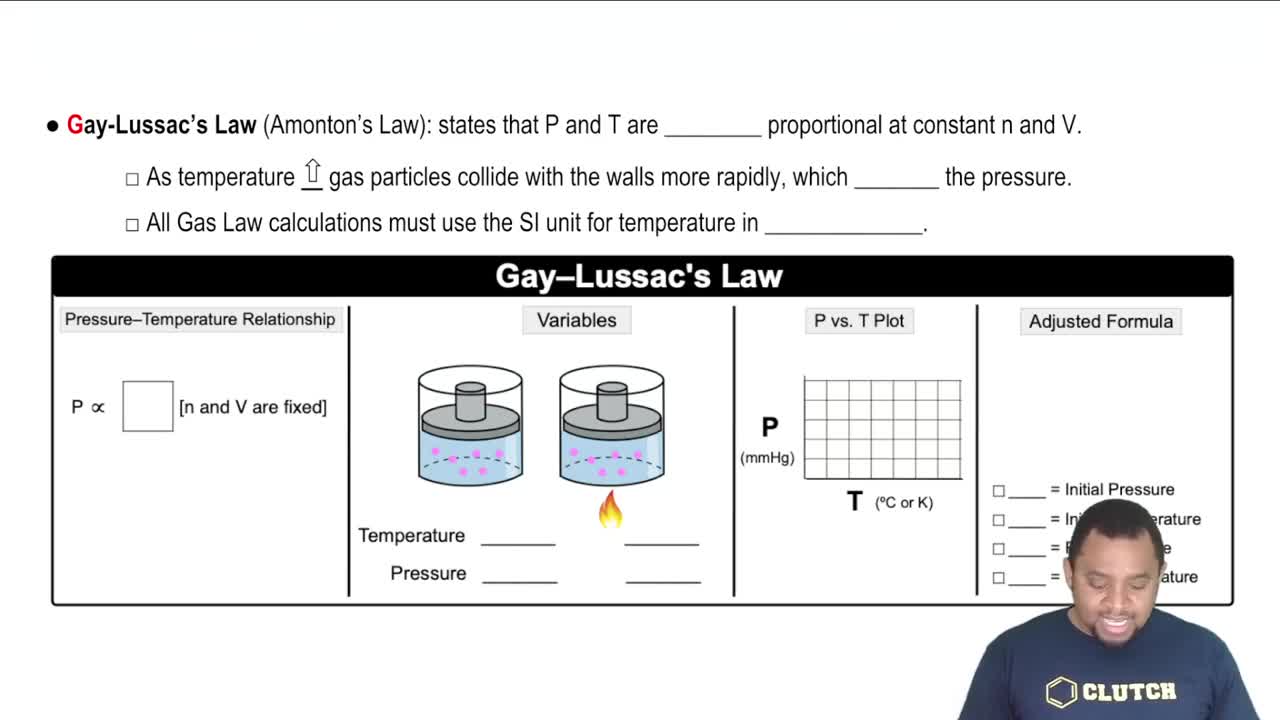
  • Which variables does Gay-Lussac's Law relate, and how are they related?

    Gay-Lussac's Law relates pressure and temperature, which are directly proportional at constant volume and moles.
  • What is the formula for Gay-Lussac's Law?

    Gay-Lussac's Law is P1/T1 = P2/T2.
  • Why must temperature be measured in Kelvin for gas law calculations?

    Temperature must be in Kelvin because gas laws require absolute temperature to ensure direct proportionality.
  • What happens to the pressure of a gas if its temperature increases while volume is constant?

    The pressure increases because gas particles move faster and collide with the container walls more forcefully.
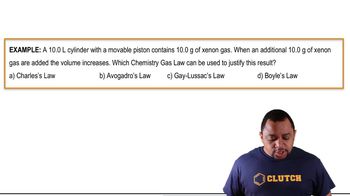
  • Which variables does Avogadro's Law relate, and how are they related?

    Avogadro's Law relates volume and moles, which are directly proportional at constant pressure and temperature.
  • What is the formula for Avogadro's Law?

    Avogadro's Law is V1/n1 = V2/n2.
  • If the number of moles of gas increases at constant pressure and temperature, what happens to the volume?

    The volume increases because volume and moles are directly proportional.
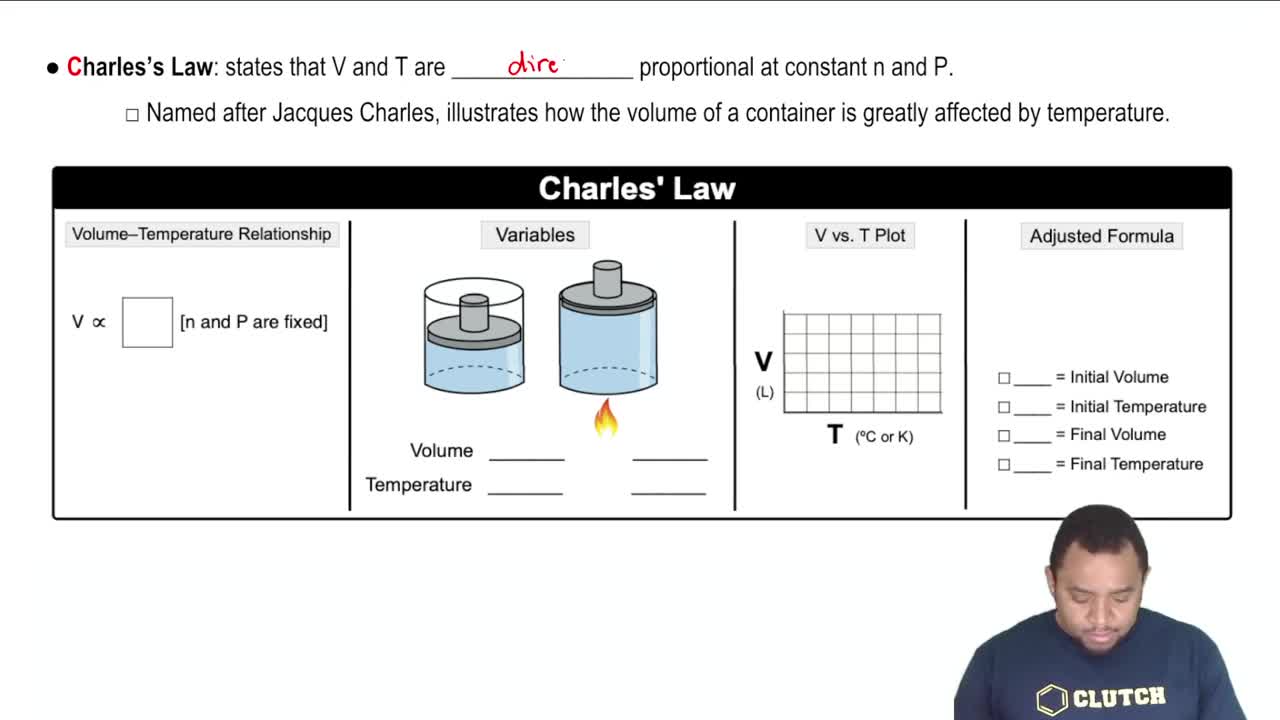
  • Which variables does Charles's Law relate, and how are they related?

    Charles's Law relates volume and temperature, which are directly proportional at constant pressure and moles.
  • What is the formula for Charles's Law?

    Charles's Law is V1/T1 = V2/T2.
  • What happens to the volume of a gas if its temperature increases while pressure is constant?

    The volume increases because the gas particles gain energy and push the piston outward.
  • How can you remember the four main chemistry gas laws and their variable pairings?

    Remember 'Be Great At Chemistry': Boyle's (Pressure & Volume), Gay-Lussac's (Pressure & Temperature), Avogadro's (Volume & Moles), Charles's (Volume & Temperature).