General Chemistry
My Course
Learn
Exam Prep
AI Tutor
Study Guides
Textbook Solutions
Flashcards
Explore
My Course
Learn
Exam Prep
AI Tutor
Study Guides
Textbook Solutions
Flashcards
Explore
Back
Clausius-Clapeyron Equation quiz #1
You can tap to flip the card.
The Clausius-Clapeyron equation relates which three values to each other?
You can tap to
flip the card.
👆
The Clausius-Clapeyron equation relates which three values to each other?
The Clausius-Clapeyron equation relates vapor pressure, temperature (in Kelvin), and the enthalpy of vaporization (ΔHvap) of a liquid.
Track progress
Control buttons has been changed to "navigation" mode.
1/10
Related flashcards
Related practice
Recommended videos
Guided course
00:59
Clausius-Clapeyron Equation
Jules
4620
views
43
rank
Guided course
02:57
Linear Form of Clausius-Clapeyron Equation
Jules
4640
views
18
rank
1
comments
Guided course
01:37
Enthalpy of Vaporization Example
Jules
3730
views
28
rank
Terms in this set (10)
Hide definitions
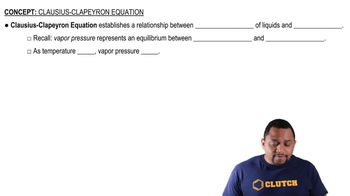
The Clausius-Clapeyron equation relates which three values to each other?
The Clausius-Clapeyron equation relates vapor pressure, temperature (in Kelvin), and the enthalpy of vaporization (ΔHvap) of a liquid.
What physical process does vapor pressure represent an equilibrium between?
Vapor pressure represents an equilibrium between condensation (gas to liquid) and vaporization (liquid to gas).
How does vapor pressure change as temperature increases according to the Clausius-Clapeyron equation?
Vapor pressure increases as temperature increases.
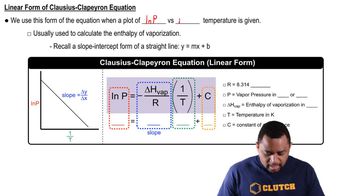
In the linear form of the Clausius-Clapeyron equation, what is plotted on the x-axis?
The x-axis plots the inverse of temperature, or 1/T.
What does the slope of a plot of ln P versus 1/T represent in the Clausius-Clapeyron equation?
The slope represents -ΔHvap/R, where ΔHvap is the enthalpy of vaporization and R is the gas constant.
What are the units of the gas constant R in the Clausius-Clapeyron equation?
The units of R are joules per mole per Kelvin (J/mol·K).
What is the typical unit for vapor pressure when using the Clausius-Clapeyron equation?
Vapor pressure is typically measured in torr or millimeters of mercury (mmHg).
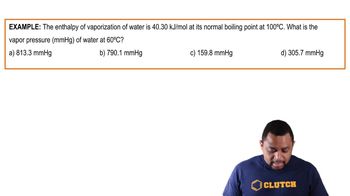
When should the two-point form of the Clausius-Clapeyron equation be used?
The two-point form is used when two temperatures and/or two vapor pressures are given.
What is the value of pressure at the normal boiling point according to the Clausius-Clapeyron equation?
At the normal boiling point, the pressure is 760 torr.
Why is it important to match the units of ΔHvap and R when using the Clausius-Clapeyron equation?
It is important because R is in joules, so ΔHvap should also be in joules per mole to ensure unit consistency in calculations.