Back

Coulomb's Law quiz

Control buttons has been changed to "navigation" mode.
1/15
  • What does Coulomb's Law allow you to calculate between two charged particles?

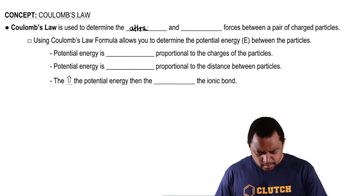
    Coulomb's Law allows you to calculate the attractive or repulsive force and the potential energy between two charged particles.
  • How is potential energy related to the magnitude of the charges in Coulomb's Law?

    Potential energy is directly proportional to the magnitude of the charges; larger charges result in greater potential energy.
  • How does the distance between charged particles affect their potential energy according to Coulomb's Law?

    Potential energy is inversely proportional to the distance between the particles; as distance increases, potential energy decreases.
  • What does a greater potential energy indicate about the strength of an ionic bond?

    A greater potential energy indicates a stronger ionic bond between the charged particles.
  • Write the formula for Coulomb's Law as given in the lesson.

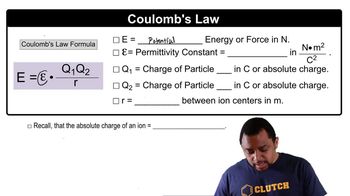
    The formula is E = k(Q1Q2)/r^2, where E is potential energy, k is the permittivity constant, Q1 and Q2 are the charges, and r is the distance between them.
  • What is the value and unit of the permittivity constant (k) in Coulomb's Law?

    The permittivity constant k is 9.0 × 10^9 N·m^2/C^2.
  • What does Q1 and Q2 represent in the Coulomb's Law formula?

    Q1 and Q2 represent the charges of the two particles, measured in coulombs.
  • In the formula E = k(Q1Q2)/r^2, what does r represent and in what unit?

    r represents the distance between the centers of the ions, measured in meters.
  • What is the absolute charge of a single ion in coulombs?

    The absolute charge of a single ion is 1.602 × 10^-19 coulombs.
  • How would you convert a charge of +2 to coulombs?

    Multiply 2 by 1.602 × 10^-19 to get 3.204 × 10^-19 coulombs.
  • If the charges of two particles are doubled, how does the potential energy change?

    The potential energy would increase by a factor of four, since it is proportional to the product of the charges.
  • If the distance between two charged particles is doubled, what happens to the potential energy?

    The potential energy decreases by a factor of four, since it is inversely proportional to the square of the distance.
  • Why is understanding Coulomb's Law important for chemistry students?

    It helps predict the behavior of ionic compounds and the strength of their bonds.
  • What is the relationship between potential energy and the strength of ionic bonds?

    A higher potential energy means a stronger ionic bond.
  • What units are used for potential energy or force in Coulomb's Law?

    Potential energy or force is measured in newtons (N) in Coulomb's Law.