Back

Density of Geometric Objects quiz

Control buttons has been changed to "navigation" mode.
1/15
  • What is the formula for density?

    Density is mass divided by volume (Density = mass/volume).
  • How do you calculate the volume of a sphere?

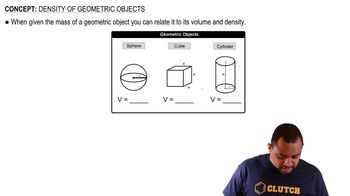
    The volume of a sphere is calculated as V = (4/3) × π × r³, where r is the radius.
  • What does the radius represent in a sphere?

    The radius is the distance from the center of the sphere to its edge.
  • What is the formula for the volume of a cube?

    The volume of a cube is V = a³, where a is the length of the cube's edge.
  • How are the sides of a cube defined?

    All sides of a cube are of equal length, labeled as 'a'.
  • What is the formula for the volume of a cylinder?

    The volume of a cylinder is V = π × r² × h, where r is the radius and h is the height.
  • Which variables are needed to calculate the volume of a cylinder?

    You need the radius and the height of the cylinder.
  • Do you need to memorize the volume formulas for geometric objects?

    No, these formulas are usually provided by instructors or on formula sheets.
  • How can you relate mass and volume to find density for geometric objects?

    By dividing the mass of the object by its calculated volume, you find its density.
  • What geometric objects are commonly used in density problems?

    Spheres, cubes, and cylinders are commonly used.
  • What is the relationship between mass, volume, and density?

    Density is the ratio of mass to volume; knowing two allows you to find the third.
  • Why is the volume formula for a sphere not required to be memorized?

    Because it is typically given in questions or on formula sheets.
  • What is the significance of the variable 'a' in the cube volume formula?

    'a' represents the edge length of the cube.
  • How does the volume formula for a cylinder differ from that of a sphere?

    The cylinder's formula includes both radius and height, while the sphere's uses only radius.
  • What is the first step in solving a density problem involving a geometric object?

    First, calculate the object's volume using its geometric formula.