Pearson+ LogoPearson+ Logo

Density quiz #1 Flashcards

Density quiz #1
Control buttons has been changed to "navigation" mode.
1/40
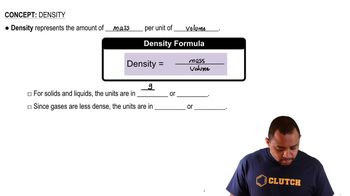
  • What is the equation for density?

    Density is calculated using the equation: density = mass / volume (d = m/V).
  • What is a curved surface in a graduated cylinder called?

    The curved surface in a graduated cylinder is called the meniscus.
  • What is the relationship between temperature and density?

    As temperature increases, density generally decreases because substances expand and their volume increases.
  • What is the formula to calculate density?

    The formula to calculate density is: density = mass / volume.
  • Which statement helps to explain why ice is less dense than liquid water?

    Ice is less dense than liquid water because its molecules are arranged in a structure that takes up more space, increasing its volume.
  • Which equation is used to determine the density of a substance?

    Density = mass / volume (d = m/V) is used to determine the density of a substance.
  • Given a graph of an object's mass and volume, how do you determine the density of the object?

    Density is determined by dividing the object's mass by its volume (d = m/V).
  • What property is measured by the amount of mass in a given volume?

    Density measures the amount of mass in a given volume.
  • Which material will displace a volume of water equal to its own volume?

    A material that is fully submerged will displace a volume of water equal to its own volume.
  • Which of the following has the greatest density?

    The substance with the highest mass per unit volume has the greatest density.
  • A sample of copper has a mass of 50 g and a volume of 5 cm³. What is its density?

    Density = 50 g / 5 cm³ = 10 g/cm³.
  • How do we calculate the density of an object?

    Density is calculated by dividing the object's mass by its volume.
  • Do substances that have less density than water sink or float?

    Substances with less density than water will float.
  • Which set of equipment would be most useful to determine the density of a liquid?

    A balance (for mass) and a graduated cylinder (for volume) are most useful for determining the density of a liquid.
  • How are mass and volume related to density?

    Density is the ratio of mass to volume (density = mass/volume).
  • Which is more dense?

    The substance with more mass in the same volume is more dense.
  • What is the formula for finding density?

    Density = mass / volume.
  • If the density of the fuel is 0.821 g/ml, what does this mean?

    It means each milliliter of fuel has a mass of 0.821 grams.
  • Which is the correct measure of density?

    Density is measured in units such as g/cm³, g/mL, or g/L.
  • How does temperature relate to density?

    Increasing temperature usually decreases density because the substance expands.
  • The density of water is approximately 1 g/cm³. Which of these objects will float on water?

    Objects with a density less than 1 g/cm³ will float on water.
  • What type of property is density?

    Density is a physical property and a characteristic property of matter.
  • When is water the densest?

    Water is densest at about 4°C.
  • What measurement(s) do you need to measure to find the density of an object?

    You need to measure the object's mass and volume.
  • What is the correct formula for density?

    Density = mass / volume.
  • Why does ice float on top of liquid water?

    Ice floats because its density is less than that of liquid water.
  • How do you find the density of an object?

    Divide the object's mass by its volume.
  • How would you calculate the density of an object?

    Measure its mass and volume, then divide mass by volume.
  • Why is density used to identify a material?

    Density is a characteristic property that helps distinguish materials.
  • Why does oil float on water?

    Oil floats because its density is less than that of water.
  • Explain why ice floats.

    Ice floats because its molecular structure makes it less dense than liquid water.
  • What is the relationship between mass and volume?

    Density is the ratio of mass to volume.
  • Which material will displace a volume of water equal to its own volume?

    A fully submerged solid will displace a volume of water equal to its own volume.
  • What is the density of titanium?

    Titanium has a density of about 4.5 g/cm³.
  • What is the density of carbon monoxide gas at STP conditions?

    The density of CO at STP is about 1.25 g/L.
  • Water has a density of 1.0 g/cm³. What is the mass of 10.0 cm³ of water?

    Mass = density × volume = 1.0 g/cm³ × 10.0 cm³ = 10.0 g.
  • Which material is least dense?

    Gases are generally the least dense materials.
  • What can be calculated by dividing the mass of matter by its volume?

    Density can be calculated by dividing mass by volume.
  • Why do some substances float on water?

    Substances float if their density is less than that of water.
  • Which type of water below would be the most dense?

    Cold, salty water is the most dense.