Diprotic Acids and Bases definitions Flashcards
Diprotic Acids and Bases definitions
You can tap to flip the card.
Control buttons has been changed to "navigation" mode.
1/14
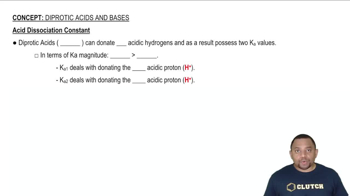
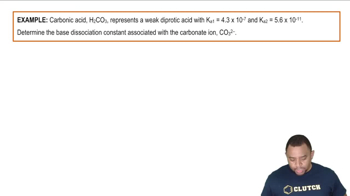
Diprotic AcidA type of acid capable of donating two hydrogen ions (H⁺) in solution, leading to two dissociation steps.Ka1The dissociation constant representing the loss of the first hydrogen ion from a diprotic acid.Ka2The dissociation constant representing the loss of the second hydrogen ion from a diprotic acid.AnionThe negatively charged ion formed when a diprotic acid donates its first hydrogen ion.BaseThe form of a diprotic acid after donating both hydrogen ions, typically carrying a negative charge.Kb1The base dissociation constant for the acceptance of the first hydrogen ion by the conjugate base of a diprotic acid.Kb2The base dissociation constant for the acceptance of the second hydrogen ion by the conjugate base of a diprotic acid.KwThe ion product constant for water, equal to the product of Ka and Kb for corresponding acid-base pairs.Equilibrium ExpressionA mathematical representation of the ratio of product concentrations to reactant concentrations at equilibrium.Carbonic AcidA weak diprotic acid that can donate two hydrogen ions, forming bicarbonate and carbonate ions.BicarbonateThe intermediate form of carbonic acid after losing one hydrogen ion, capable of further dissociation.Carbonate IonThe fully deprotonated form of carbonic acid, carrying a 2- charge after losing both hydrogen ions.Hydronium IonThe ion formed when water gains a hydrogen ion, represented as H₃O⁺.Intermediate FormThe state of a diprotic acid after donating its first hydrogen ion, before losing the second.