Back

Empirical Formula quiz

Control buttons has been changed to "navigation" mode.
1/15
  • What does the empirical formula of a compound represent?

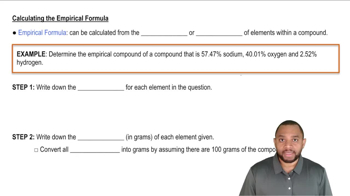
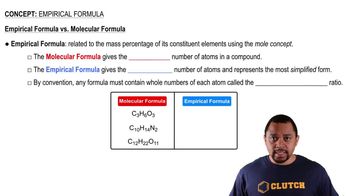
    The empirical formula represents the simplest whole number ratio of the elements in a compound.
  • How is the empirical formula related to mass percentage?

    The empirical formula is derived from the mass percentages of the constituent elements using the mole concept.
  • What does the molecular formula of a compound indicate?

    The molecular formula shows the exact number of atoms of each element present in a compound.
  • How do you obtain the empirical formula from a molecular formula?

    Divide the subscripts in the molecular formula by their greatest common divisor to get the empirical formula.
  • If a compound has a molecular formula of C6H12O6, what is its empirical formula?

    Its empirical formula is CH2O, since 6, 12, and 6 are all divisible by 6.
  • What is the empirical formula for a compound with the molecular formula C10H14N2?

    The empirical formula is C5H7N, after dividing each subscript by 2.
  • When are the empirical and molecular formulas the same?

    They are the same when the subscripts in the molecular formula cannot be reduced by a common factor.
  • What is the empirical formula for C12H22O11?

    The empirical formula is C12H22O11, since the subscripts cannot be reduced further.
  • What does the mole concept help us do in relation to empirical formulas?

    The mole concept helps us convert between grams, moles, and the number of atoms or molecules to determine empirical formulas.
  • Why must the empirical formula have whole numbers for each atom?

    Because chemical formulas represent actual atoms, which cannot be fractional.
  • What is the main difference between empirical and molecular formulas?

    The empirical formula shows the simplest ratio of elements, while the molecular formula shows the actual number of each atom.
  • Can the empirical formula ever be larger than the molecular formula?

    No, the empirical formula is always equal to or a reduced form of the molecular formula.
  • Why is understanding empirical formulas important in chemistry?

    It is crucial for analyzing composition and calculating the molar mass of substances.
  • What is meant by the 'whole number ratio' in empirical formulas?

    It refers to the smallest possible integer ratio of the elements in a compound.
  • If a compound's empirical and molecular formulas are identical, what does this indicate?

    It indicates that the actual number of atoms in the molecule cannot be simplified further.