Enthalpy of Formation quiz #1 Flashcards
Enthalpy of Formation quiz #1
You can tap to flip the card.
Control buttons has been changed to "navigation" mode.
1/11
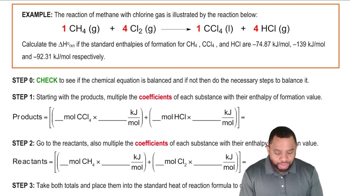
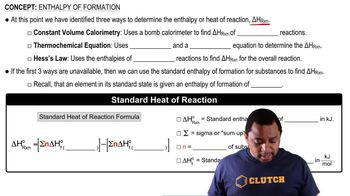
Which statement about enthalpy is true?Enthalpy change (ΔH) represents the heat absorbed or released during a chemical reaction at constant pressure.Which substance has a standard enthalpy of formation of zero?Any element in its standard state, such as O2(g), H2(g), or N2(g), has a standard enthalpy of formation (ΔHf°) of zero.For which of the following reactions does ΔHrxn represent an enthalpy of formation?ΔHrxn represents an enthalpy of formation when one mole of a compound is formed from its elements in their standard states.What does it mean when the enthalpy change for a reaction is negative?A negative enthalpy change means the reaction is exothermic and releases heat to the surroundings.What is the difference between the enthalpies of the products and the reactants?The difference between the enthalpies of the products and reactants gives the enthalpy change (ΔH) for the reaction.Which of the following has a standard enthalpy of formation value (ΔHf°) of zero at 298 K?An element in its standard state, such as O2(g), has a ΔHf° of zero at 298 K.The enthalpy of formation of water is –285.8 kJ/mol. What can be inferred from this statement?Forming one mole of water from its elements in their standard states releases 285.8 kJ of energy.Which statement about ΔHf° is true?ΔHf° is zero for elements in their standard states and represents the enthalpy change when one mole of a compound forms from its elements.Which of the following reactions would have an enthalpy change equal to ΔHf°? Select all that apply.Any reaction where one mole of a compound is formed from its elements in their standard states will have an enthalpy change equal to ΔHf°.What is the ΔHf° value for CH4(g) in kJ/mol?The standard enthalpy of formation (ΔHf°) for CH4(g) is typically –74.8 kJ/mol.Which substance has ΔHf° defined as 0 kJ/mol: H2O(s), Ne(l), F2(g), or CO2(g)?F2(g) has ΔHf° defined as 0 kJ/mol because it is an element in its standard state.