Back

Equatorial and Axial Positions quiz

Control buttons has been changed to "navigation" mode.
1/15
  • What are equatorial positions in molecular geometry?

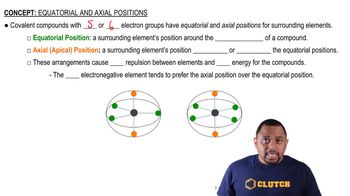
    Equatorial positions are the locations around the central atom's equator where surrounding elements are placed in molecules with five or six electron groups.
  • Where are axial positions located in a molecule with five or six electron groups?

    Axial positions are above and below the equatorial plane of the central atom in such molecules.
  • How many equatorial positions are there in a molecule with five electron groups?

    There are three equatorial positions in a molecule with five electron groups.
  • How many equatorial positions are present in a molecule with six electron groups?

    There are four equatorial positions in a molecule with six electron groups.
  • Why do more electronegative elements prefer the axial position?

    More electronegative elements prefer the axial position because it leads to lower energy and greater stability.
  • What is the effect of electron group arrangement on molecular stability?

    The arrangement affects repulsion between elements, and minimizing repulsion decreases energy, increasing stability.
  • In a six electron group system, where are lone pairs most stable?

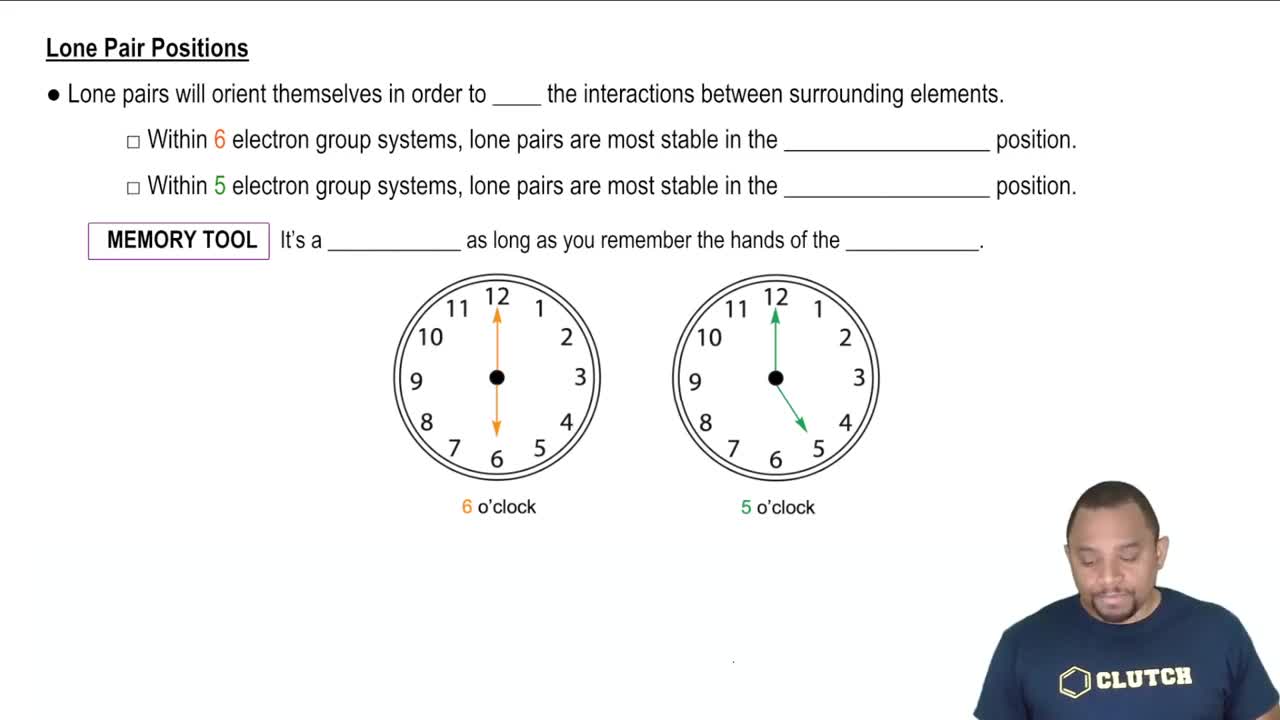
    Lone pairs are most stable in the axial positions in a six electron group system.
  • In a five electron group system, where are lone pairs most stable?

    Lone pairs are most stable in the equatorial positions in a five electron group system.
  • What mnemonic helps remember lone pair stability in six electron group systems?

    The mnemonic is '6 o'clock for 6 electron groups,' where hands point straight up and down like axial positions.
  • What mnemonic helps remember lone pair stability in five electron group systems?

    The mnemonic is '5 o'clock for 5 electron groups,' where hands are not straight up and down, representing equatorial positions.
  • Why do lone pairs orient themselves in certain positions in these molecules?

    Lone pairs orient to decrease interactions and repulsion with surrounding elements, increasing stability.
  • How does the arrangement of electron groups affect the energy of a compound?

    Proper arrangement decreases repulsion, which lowers the compound's energy and increases its stability.
  • What is the main difference between equatorial and axial positions?

    Equatorial positions are around the equator of the central atom, while axial positions are above and below this plane.
  • How can you visualize the equatorial and axial positions using a clock analogy?

    6 o'clock represents axial positions (straight up and down), and 5 o'clock represents equatorial positions (not straight up and down).
  • What should you consider when drawing the most accurate structure for molecules with five or six electron groups?

    You should consider the positions of lone pairs and place them where they are most stable—axial for six groups, equatorial for five.