Back

Formal Charge quiz

Control buttons has been changed to "navigation" mode.
1/15
  • What does formal charge represent in a molecule?

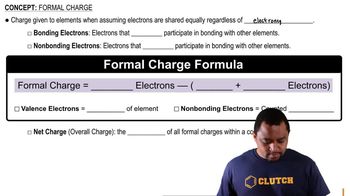
    Formal charge represents the charge assigned to an atom assuming electrons are shared equally, regardless of electronegativity.
  • How are electrons assumed to be shared when calculating formal charge?

    Electrons are assumed to be shared equally between atoms, ignoring differences in electronegativity.
  • What is the formula for calculating formal charge?

    Formal charge = valence electrons - number of bonds - nonbonding electrons.
  • How do you determine the number of valence electrons for an element?

    Valence electrons correspond to the group number of the element in the periodic table.
  • What are bonding electrons?

    Bonding electrons are electrons that participate in chemical bonds with other elements.
  • What are nonbonding electrons?

    Nonbonding electrons are electrons that do not participate in bonding with other elements.
  • How are nonbonding electrons counted when calculating formal charge?

    Nonbonding electrons are counted individually for each atom.
  • What is the net charge of a compound?

    The net charge is the sum of all formal charges within a compound.
  • Why is formal charge important in chemistry?

    Formal charge helps predict the stability and reactivity of molecules in chemical reactions.
  • Does formal charge take electronegativity into account?

    No, formal charge assumes equal sharing of electrons and ignores electronegativity differences.
  • What happens to the electron cloud of a more electronegative atom in reality?

    A more electronegative atom holds electrons more tightly, making its electron cloud larger.
  • What is the purpose of calculating formal charge for each atom in a molecule?

    Calculating formal charge for each atom helps determine the net charge and identify the most stable structure.
  • How does formal charge relate to the overall charge of a molecule?

    The sum of all formal charges gives the overall (net) charge of the molecule.
  • What is the difference between bonding and nonbonding electrons?

    Bonding electrons are shared in bonds, while nonbonding electrons are not involved in bonding.
  • How can formal charge help in predicting molecular reactivity?

    Atoms with unusual formal charges may be more reactive, helping chemists predict reaction sites.