Skip to main content
General Chemistry
My Course
Learn
Exam Prep
AI Tutor
Study Guides
Textbook Solutions
Flashcards
Explore
Try the app
My Course
Learn
Exam Prep
AI Tutor
Study Guides
Textbook Solutions
Flashcards
Explore
Try the app
Back
Gibbs Free Energy And Equilibrium quiz
You can tap to flip the card.
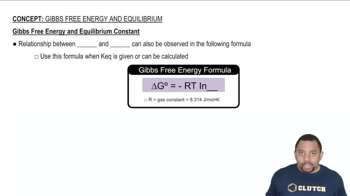
What equation relates standard Gibbs free energy (ΔG°) to the equilibrium constant (K)?
You can tap to flip the card.
👆
What equation relates standard Gibbs free energy (ΔG°) to the equilibrium constant (K)?
ΔG° = -RTln(K) relates standard Gibbs free energy to the equilibrium constant, where R is the gas constant and T is temperature in Kelvin.
Track progress
Control buttons has been changed to "navigation" mode.
1/15
Related flashcards
Related practice
Recommended videos
Gibbs Free Energy And Equilibrium definitions
Gibbs Free Energy And Equilibrium
11 Terms
Gibbs Free Energy & Equilibrium
19. Chemical Thermodynamics
5 problems
Topic
Jules
19. Chemical Thermodynamics - Part 1 of 2
5 topics
7 problems
Chapter
Jules
19. Chemical Thermodynamics - Part 2 of 2
3 topics
8 problems
Chapter
Jules
Guided course
01:13
∆G° and K Example
2797
views
16
rank
2
comments
Guided course
01:19
∆G° and K
3177
views
17
rank
Guided course
01:03
∆G, ∆G° and Q
2753
views
17
rank
Terms in this set (15)
Hide definitions
What equation relates standard Gibbs free energy (ΔG°) to the equilibrium constant (K)?
ΔG° = -RTln(K) relates standard Gibbs free energy to the equilibrium constant, where R is the gas constant and T is temperature in Kelvin.
What is the value and units of the gas constant (R) used in Gibbs free energy calculations?
R = 8.314 J/(mol·K) is used when dealing with energy calculations involving Gibbs free energy.
When should you use the equation ΔG° = -RTln(K)?
Use this equation when the equilibrium constant (K) is given or can be calculated under standard conditions.
What does the equilibrium constant (K) represent in the context of Gibbs free energy?
K represents the position of equilibrium for a reaction under standard conditions.
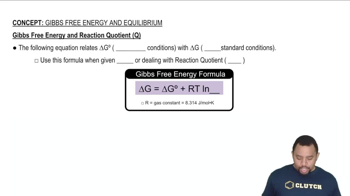
What equation is used to calculate Gibbs free energy under non-standard conditions?
ΔG = ΔG° + RTln(Q) is used, where Q is the reaction quotient.
What is the reaction quotient (Q) and how does it differ from K?
Q is the ratio of product to reactant concentrations at any point, while K is the ratio at equilibrium.
Why is the gas constant R used in the form 8.314 J/(mol·K) for Gibbs free energy calculations?
This form is used because Gibbs free energy calculations involve energy, which is measured in joules or kilojoules.
What does a negative ΔG° indicate about a reaction’s spontaneity?
A negative ΔG° means the reaction is spontaneous under standard conditions.
How does the equation ΔG = ΔG° + RTln(Q) connect standard and non-standard conditions?
It allows calculation of Gibbs free energy for any conditions by relating it to the standard value and the reaction quotient.
What is the significance of the ln(K) term in the ΔG° equation?
ln(K) links the thermodynamic favorability of a reaction to its equilibrium position.
What units should temperature (T) be in when using Gibbs free energy equations?
Temperature should be in Kelvin (K) for these calculations.
What does it mean if ΔG is zero for a reaction?
ΔG = 0 means the reaction is at equilibrium under the given conditions.
How can you predict the direction of a reaction using ΔG?
If ΔG is negative, the reaction proceeds forward; if positive, it proceeds in reverse.
What is the relationship between ΔG° and K when K > 1?
When K > 1, ΔG° is negative, indicating a spontaneous reaction under standard conditions.
Why are Gibbs free energy equations important in chemistry?
They help predict reaction spontaneity and connect thermodynamic quantities to chemical equilibrium.
 BackBack
 01:13
01:13