Skip to main content
General Chemistry
My Course
Learn
Exam Prep
AI Tutor
Study Guides
Textbook Solutions
Flashcards
Explore
Try the app
My Course
Learn
Exam Prep
AI Tutor
Study Guides
Textbook Solutions
Flashcards
Explore
Try the app
Back
Gibbs Free Energy quiz
You can tap to flip the card.
What does a negative value of Gibbs free energy (ΔG) indicate about a reaction?
You can tap to flip the card.
👆
What does a negative value of Gibbs free energy (ΔG) indicate about a reaction?
A negative ΔG means the reaction is spontaneous.
Track progress
Control buttons has been changed to "navigation" mode.
1/15
Related flashcards
Related practice
Recommended videos
Gibbs Free Energy definitions
Gibbs Free Energy
10 Terms
Gibbs Free Energy
19. Chemical Thermodynamics
7 problems
Topic
Jules
19. Chemical Thermodynamics - Part 1 of 2
5 topics
7 problems
Chapter
Jules
19. Chemical Thermodynamics - Part 2 of 2
3 topics
8 problems
Chapter
Jules
Guided course
03:38
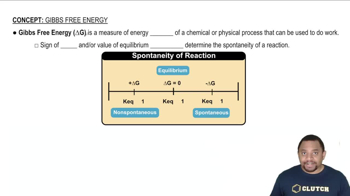
Spontaneity of Reactions
4759
views
39
rank
2
comments
Guided course
01:23
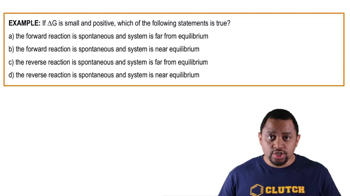
ΔG and Spontaneity Example
3841
views
38
rank
1
comments
Guided course
02:42
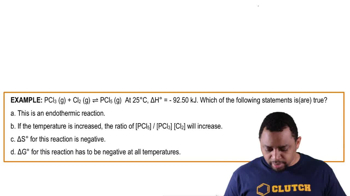
Spontaneity and Temperature Example
3505
views
25
rank
Terms in this set (15)
Hide definitions
What does a negative value of Gibbs free energy (ΔG) indicate about a reaction?
A negative ΔG means the reaction is spontaneous.
What is the equation for Gibbs free energy?
ΔG = ΔH - TΔS, where ΔH is enthalpy, T is temperature, and ΔS is entropy.
What does it mean if ΔG is zero for a reaction?
If ΔG is zero, the reaction is at equilibrium.
How does the equilibrium constant (K) relate to reaction spontaneity?
If K > 1, the reaction is spontaneous; if K < 1, it is non-spontaneous.
What does a positive ΔG value indicate about a chemical reaction?
A positive ΔG means the reaction is non-spontaneous.
What is the relationship between ΔG and K at equilibrium?
At equilibrium, ΔG is zero and K equals 1.
If ΔH and ΔS are both positive, when is the reaction spontaneous?
The reaction is spontaneous at high temperatures.
If ΔH and ΔS are both negative, when is the reaction spontaneous?
The reaction is spontaneous at low temperatures.
What happens if ΔH is positive and ΔS is negative?
The reaction is always non-spontaneous.
What happens if ΔH is negative and ΔS is positive?
The reaction is always spontaneous.
How can you predict reaction spontaneity if the sign of ΔG is unknown?
You can use the signs of ΔH and ΔS to predict spontaneity.
What does it mean if the equilibrium constant K is less than 1?
It means the reaction is non-spontaneous and reactants dominate.
What does it mean if the equilibrium constant K is greater than 1?
It means the reaction is spontaneous and products dominate.
What does the term 'spontaneous' mean in the context of chemical reactions?
It means the reaction can proceed without external input of energy.
How do the signs of ΔH and ΔS affect the temperature dependence of spontaneity?
If both are positive, spontaneity increases with temperature; if both are negative, spontaneity increases as temperature decreases.
 BackBack
 03:38
03:38