Skip to main content
General Chemistry
My Course
Learn
Exam Prep
AI Tutor
Study Guides
Textbook Solutions
Flashcards
Explore
Try the app
My Course
Learn
Exam Prep
AI Tutor
Study Guides
Textbook Solutions
Flashcards
Explore
Try the app
Back
Henry's Law Calculations quiz
You can tap to flip the card.
What does Henry's law describe in relation to gases?
You can tap to flip the card.
👆
What does Henry's law describe in relation to gases?
Henry's law describes the relationship between the solubility of a gas and its partial pressure.
Track progress
Control buttons has been changed to "navigation" mode.
1/15
Related flashcards
Related practice
Recommended videos
Henry's Law Calculations definitions
Henry's Law Calculations
11 Terms
Henry's Law Calculations
14. Solutions
3 problems
Topic
Jules
The Colligative Properties
14. Solutions
4 problems
Topic
Jules
14. Solutions - Part 1 of 3
4 topics
8 problems
Chapter
Jules
14. Solutions - Part 2 of 3
5 topics
10 problems
Chapter
Jules
14. Solutions - Part 3 of 3
5 topics
6 problems
Chapter
Jules
Guided course
01:59
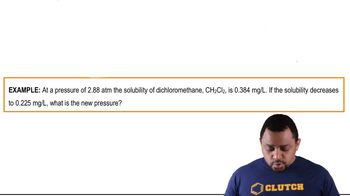
Henry's Law Two-point Formula Example
3369
views
20
rank
Guided course
01:40
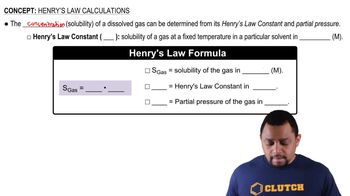
Henry's Law Calculations
5147
views
27
rank
Guided course
01:03
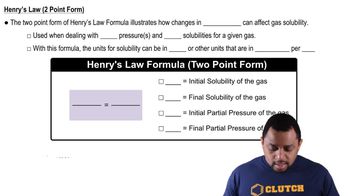
Henry's Law Two-point Formula
3880
views
16
rank
Terms in this set (15)
Hide definitions
What does Henry's law describe in relation to gases?
Henry's law describes the relationship between the solubility of a gas and its partial pressure.
What is the formula for Henry's law?
The formula is S_gas = k_H × P_gas, where S_gas is solubility, k_H is Henry's law constant, and P_gas is the partial pressure of the gas.
What does the variable k_H represent in Henry's law?
k_H is Henry's law constant, representing the solubility of a gas at a fixed temperature in a particular solvent, in units of molarity/pressure.
What units are commonly used for Henry's law constant?
Henry's law constant is usually given in molarity per atmosphere (M/atm), but can also be in M/torr or M/mmHg.
Why is it important to keep units consistent when using Henry's law?
Consistent units are necessary to ensure accurate calculations, especially for pressure and Henry's law constant.
What does S_gas represent in the Henry's law equation?
S_gas represents the solubility of the gas, typically in molarity (M).
How does changing the partial pressure of a gas affect its solubility according to Henry's law?
Solubility is directly proportional to the partial pressure of the gas; increasing pressure increases solubility.
What is the two-point form of Henry's law used for?
The two-point form is used to compare solubilities and pressures under two different sets of conditions for a given gas.
Write the two-point form of Henry's law.
The two-point form is S1/P1 = S2/P2, where S1 and S2 are solubilities and P1 and P2 are pressures.
What should you do if the pressure units for Henry's law constant and partial pressure do not match?
You should convert all pressure units to be consistent, typically to atmospheres, before using the formula.
What is another term for solubility in the context of Henry's law?
Solubility is also referred to as concentration or molarity.
In what units can solubility be expressed when using Henry's law?
Solubility can be expressed in molarity (M) or in mass per volume units.
What does P_gas represent in the Henry's law equation?
P_gas is the partial pressure of the gas, usually measured in atmospheres.
How does temperature affect Henry's law constant?
Henry's law constant varies with temperature and the solvent used.
When should you use the two-point form of Henry's law?
Use the two-point form when you have two different pressures and/or solubilities for the same gas.
 BackBack
 01:59
01:59