Skip to main content
General Chemistry
My Course
Learn
Exam Prep
AI Tutor
Study Guides
Textbook Solutions
Flashcards
Explore
Try the app
My Course
Learn
Exam Prep
AI Tutor
Study Guides
Textbook Solutions
Flashcards
Explore
Try the app
Back
Intro to Henry's Law quiz
You can tap to flip the card.
What does Henry's Law state about the solubility of a gas in a liquid?
You can tap to flip the card.
👆
What does Henry's Law state about the solubility of a gas in a liquid?
Henry's Law states that the solubility of a gas in a liquid is directly proportional to the partial pressure of the gas above the liquid.
Track progress
Control buttons has been changed to "navigation" mode.
1/15
Related flashcards
Related practice
Recommended videos
Intro to Henry's Law definitions
Intro to Henry's Law
11 Terms
Intro to Henry's Law quiz #1
Intro to Henry's Law
10 Terms
Intro to Henry's Law
14. Solutions
4 problems
Topic
Jules
Henry's Law Calculations
14. Solutions
4 problems
Topic
Jules
14. Solutions - Part 1 of 3
4 topics
12 problems
Chapter
Jules
14. Solutions - Part 2 of 3
5 topics
12 problems
Chapter
Jules
14. Solutions - Part 3 of 3
5 topics
12 problems
Chapter
Jules
Guided course
00:32
Henry's Law Example
4156
views
23
rank
Guided course
02:14
Henry's Law Solubility
5074
views
33
rank
Terms in this set (15)
Hide definitions
What does Henry's Law state about the solubility of a gas in a liquid?
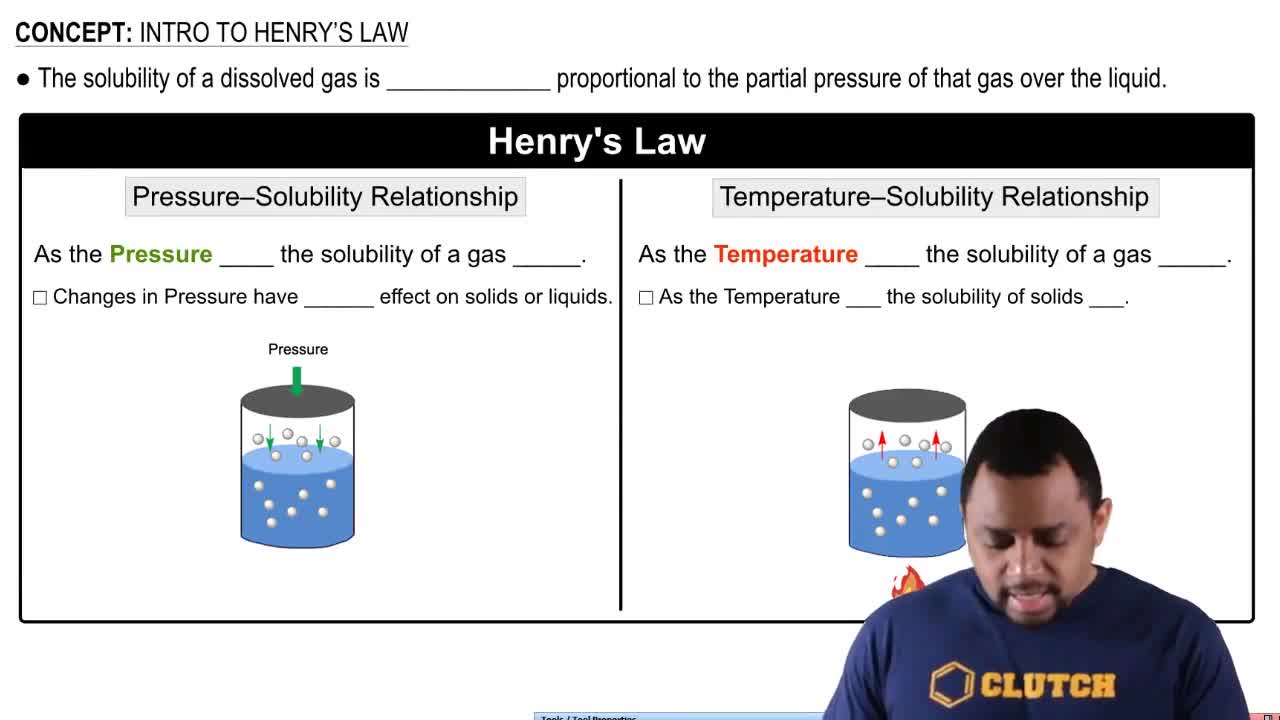
Henry's Law states that the solubility of a gas in a liquid is directly proportional to the partial pressure of the gas above the liquid.
How does increasing the pressure above a liquid affect the solubility of a gas?
Increasing the pressure above a liquid increases the solubility of a gas because more gas is forced into the liquid.
Does changing pressure affect the solubility of solids or liquids?
No, changes in pressure do not affect the solubility of solids or liquids, only gases.
What happens to the solubility of a gas as temperature increases?
As temperature increases, the solubility of a gas decreases because the gas escapes from the liquid.
How does temperature affect the solubility of solids?
Increasing temperature increases the solubility of solids, making them dissolve more readily in the solvent.
What is solubility?
Solubility is the ability of a solute to dissolve in a solvent.
What is an example of gas solubility decreasing with temperature?
When water boils and steam escapes, the gas is leaving the liquid, showing decreased solubility.
What is the relationship between pressure and gas solubility according to Henry's Law?
Gas solubility increases as the partial pressure of the gas above the liquid increases.
Does Henry's Law apply to solids and liquids?
No, Henry's Law only applies to gases, not solids or liquids.
What happens to a solid's solubility when the temperature is increased?
A solid's solubility increases when the temperature is increased.
Why does gas escape from boiling water?
Gas escapes from boiling water because higher temperature decreases the solubility of the gas in the liquid.
If you increase the pressure on a gas above a liquid, what happens?
Increasing the pressure forces more gas into the liquid, increasing its solubility.
What two factors affect solubility discussed in Henry's Law?
Pressure and temperature are the two factors that affect solubility in the context of Henry's Law.
How does the solubility of a solid change with temperature compared to a gas?
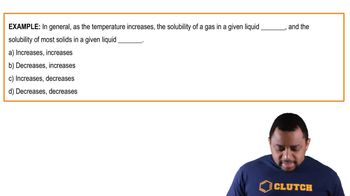
As temperature increases, solid solubility increases, but gas solubility decreases.
What is an everyday example of increased solid solubility with temperature?
A solid like a rock dissolving more when boiled in water is an example of increased solid solubility with temperature.
 BackBack
 00:32
00:32