What types of intermolecular forces are found in CH4?
CH4 has only London dispersion forces.
What type(s) of intermolecular forces are expected between H2O molecules?
H2O molecules have hydrogen bonding, dipole-dipole, and London dispersion forces.
Which of the following compounds would have the strongest intermolecular forces?
An ionic compound dissolved in water has the strongest intermolecular forces (ion-dipole).
What are the weakest attractions between molecules?
London dispersion forces are the weakest attractions between molecules.
What types of forces exist between molecules of CO2?
CO2 molecules experience London dispersion forces.
Which intermolecular forces exist between two CH4 molecules?
London dispersion forces exist between two CH4 molecules.
Which attractive force is the weakest force between molecules?
London dispersion force is the weakest between molecules.
In which of the following liquids do the intermolecular forces include dipole-dipole forces?
Polar liquids like CH3Cl include dipole-dipole forces.
Which molecule will have dipole-dipole forces with like molecules?
A polar molecule like SO2 will have dipole-dipole forces with like molecules.
Which compound is capable of dipole–dipole interactions?
Polar compounds like CH3Cl are capable of dipole–dipole interactions.
Which type of intermolecular force is the weakest?
London dispersion force is the weakest intermolecular force.
Which intermolecular force is present in all condensed phases?
London dispersion forces are present in all condensed phases.
Which molecules exhibit only London (dispersion) forces?
Nonpolar molecules like CH4 and CCl4 exhibit only London dispersion forces.
Which physical property demonstrates strong intermolecular forces?
A high boiling point demonstrates strong intermolecular forces.
Which molecules can form hydrogen bonds with water?
Molecules with H bonded to O, N, or F, such as NH3 and HF, can form hydrogen bonds with water.
Which of the substances have polar interactions (dipole–dipole forces) between molecules?
Polar substances like SO2 and CH3Cl have dipole–dipole forces.
What is the strongest type of intermolecular force of attraction present in CH3OH?
Hydrogen bonding is the strongest force in CH3OH.
Which of the following states of matter would have stronger intermolecular forces at work?
Solids have stronger intermolecular forces at work than liquids or gases.
Why does a comet's tail point away from the sun?
This is unrelated to intermolecular forces; revise: Why do water molecules in a comet's tail remain together? Due to intermolecular forces such as hydrogen bonding.
Which object absorbs the most visible light?
This is unrelated to intermolecular forces; revise: Which type of intermolecular force is responsible for the high surface tension of water? Hydrogen bonding.
What intermolecular forces are present between two molecules of CH3CH2SH?
CH3CH2SH molecules have dipole-dipole and London dispersion forces.
Which of the following compounds can form intermolecular hydrogen bonds?
Compounds with H bonded to O, N, or F, such as NH3 and H2O, can form intermolecular hydrogen bonds.
Which of the following is true regarding the origin of dipole forces between molecules?
Dipole forces originate from the attraction between permanent dipoles in polar molecules.
Which diagram best shows a set of polar molecules interacting through dipole–dipole interactions?
A diagram showing molecules with opposite partial charges aligned and attracted to each other best represents dipole–dipole interactions.
Rank the following based on increasing intermolecular forces: C2H6
C2H6 has only London dispersion forces, which are weak compared to polar or hydrogen-bonding molecules.
Which of the following best represents dipole-dipole forces between these two CH3CH2OCH3 molecules?
A diagram showing the positive end of one molecule attracted to the negative end of another represents dipole-dipole forces.
Which of the substances has polar interactions (dipole–dipole forces) between molecules?
Polar substances like CH3Cl and SO2 have dipole–dipole forces.
Which of the following pairs is arranged with the particle of higher polarizability listed first?
A larger, heavier atom or molecule is more polarizable, such as I2 before F2.
Which of the following statements correctly describe dipole-dipole forces? Select all that apply.
Dipole-dipole forces occur between polar molecules and are stronger than dispersion forces but weaker than hydrogen bonding.
Which of the following could enter into H-bonding interactions with water?
Molecules with H bonded to O, N, or F, such as NH3 and HF, can enter into H-bonding with water.
What intermolecular forces are important for the molecule below? [check all that apply.]
Depending on the molecule, possible forces include London dispersion, dipole-dipole, and hydrogen bonding.
Which statement best describes the ion-dipole interaction occurring when KI is dissolved in water?
Ion-dipole interactions occur between K+ or I- ions and the polar water molecules.
Which ranks these materials by the attraction between their atoms from the weakest to the strongest?
London dispersion < dipole-dipole < hydrogen bonding < ion-dipole.
Which force keeps molecules in a fluid together: weak electromagnetic or strong nuclear?
Weak electromagnetic (intermolecular) forces keep molecules in a fluid together.
Which property is responsible for the fact that water and oil do not mix?
Polarity is responsible for water and oil not mixing.
Which of the following effects is produced by the high surface tension of water?
Water forms beads on surfaces due to high surface tension.
What intermolecular forces are present in pure samples of both CH3F and CF4?
CH3F has dipole-dipole and dispersion forces; CF4 has only dispersion forces.
Ammonia and hydrogen fluoride both have unusually high boiling points due to _____
Hydrogen bonding.
Classify each substance based on the intermolecular forces present in that substance.
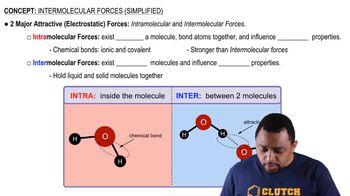
Substances may have London dispersion, dipole-dipole, hydrogen bonding, or ion-dipole forces depending on their structure.
There are attractive forces between atoms of liquids with a high viscosity.
Liquids with high viscosity have strong intermolecular forces.