Intermolecular Forces quiz #6 Flashcards

Intermolecular Forces quiz #6
Control buttons has been changed to "navigation" mode.
1/40
  • Water has surface tension because

    Water has surface tension because of strong hydrogen bonding between molecules.
  • Which term identifies a type of intermolecular force?

    Dipole-dipole is a type of intermolecular force.
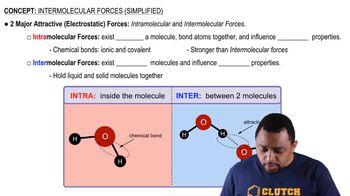
  • ____ ____ force is the type of intermolecular force that would be present between molecules of Cl2.

    London dispersion force is present between Cl2 molecules.
  • Based on table H, which compound has the strongest intermolecular forces at 60 kPa?

    The compound with the lowest vapor pressure at 60 kPa has the strongest intermolecular forces.
  • What intermolecular forces are present between two molecules of CH3CF3?

    CH3CF3 molecules have dipole-dipole and London dispersion forces.
  • The strongest intermolecular force is ____ ____.

    Ion-dipole.
  • The only substance with a higher surface tension than water is _____.

    Mercury.
  • Neon atoms are attracted to each other by

    London dispersion forces.
  • A measure of how difficult it is to stretch or break the surface of a liquid

    Surface tension.
  • Intermolecular forces allow which substance to be the least fluid?

    A substance with strong intermolecular forces, such as water, is the least fluid.
  • Ice is held together in a ________ structure.

    Hydrogen-bonded lattice structure.
  • The predominant intermolecular force found in Na+(aq) is _____

    Ion-dipole force.
  • Identify the type of intermolecular force(s) between NH3 and another NH3 molecule.

    Hydrogen bonding, dipole-dipole, and London dispersion forces.
  • Which of the following best describes very weak, brief attractions between neutral atoms?

    London dispersion forces.
  • The partial charges across one molecule of water occur because of

    Differences in electronegativity between hydrogen and oxygen.
  • Does soap break hydrogen bonds?

    Soap can disrupt hydrogen bonds, reducing water's surface tension.
  • A hydrogen atom in a given water molecule is strongly attracted to

    The oxygen atom in a neighboring water molecule.
  • Does Cl2 have dipole-dipole forces?

    No, Cl2 is nonpolar and only has London dispersion forces.
  • What kinds of attractive forces may exist between particles in molecular crystals?

    London dispersion, dipole-dipole, and hydrogen bonding may exist in molecular crystals.
  • Polar attractions are

    Polar attractions are dipole-dipole interactions between polar molecules.
  • The predominant intermolecular force between molecules of I2 is _____

    London dispersion force.
  • Polarity and intermolecular forces gizmo

    Polarity determines the type of intermolecular forces present: polar molecules have dipole-dipole and possibly hydrogen bonding; nonpolar have only dispersion.
  • Why is I2 a solid at room temperature?

    I2 is a solid due to strong London dispersion forces from its large size and many electrons.
  • NH3 intermolecular forces

    NH3 has hydrogen bonding, dipole-dipole, and London dispersion forces.
  • HCLO intermolecular forces

    HCLO has dipole-dipole and London dispersion forces.
  • Which compound would you expect to have greater surface tension, acetone [(CH3)2CO] or water (H2O)?

    Water (H2O) has greater surface tension due to hydrogen bonding.
  • In a pure sample of HF, what forces of attraction exist between the molecules?

    HF molecules have hydrogen bonding, dipole-dipole, and London dispersion forces.
  • What is the strongest type of intermolecular force present in NH2CH3?

    Hydrogen bonding is the strongest force in NH2CH3.
  • Rank the following based on increasing intermolecular forces: C2H6, C4H10, C6H14, C8H18

    C2H6 < C4H10 < C6H14 < C8H18 (increasing London dispersion forces with size).
  • Decide which intermolecular forces act between the molecules of each compound in the table below.

    Each compound may have London dispersion, dipole-dipole, or hydrogen bonding depending on its structure.
  • Identify the predominant intermolecular force.

    The predominant force depends on the substance: ion-dipole, hydrogen bonding, dipole-dipole, or dispersion.
  • Identify the intermolecular forces present in each of these substances.

    Each substance may have London dispersion, dipole-dipole, hydrogen bonding, or ion-dipole forces.
  • List the intermolecular forces present in the following molecule:

    Depending on the molecule, possible forces include London dispersion, dipole-dipole, and hydrogen bonding.
  • Ammonia's unusually high melting point is the result of

    Hydrogen bonding.
  • Rank the following in order of increasing strength of their respective intermolecular forces.

    London dispersion < dipole-dipole < hydrogen bonding < ion-dipole.
  • Identify which of the following molecules can exhibit hydrogen bonding as a pure liquid.

    Molecules with H bonded to O, N, or F, such as H2O and NH3, can exhibit hydrogen bonding.
  • List the intermolecular forces present in the following molecule.

    Depending on the molecule, possible forces include London dispersion, dipole-dipole, and hydrogen bonding.
  • Water molecules stay close to each other as a result of existence of

    Hydrogen bonding.
  • Identify the true statements about surface tension.

    Surface tension is caused by strong intermolecular forces and allows liquids to form beads.
  • O2 intermolecular forces

    O2 molecules have only London dispersion forces.