What type of intermolecular force holds base pairs together in molecules such as DNA?
Base pairs are held together by hydrogen bonding, which is an intermolecular force occurring when hydrogen is directly bonded to fluorine, oxygen, or nitrogen.
Which intermolecular force is responsible for the attraction between base pairs in biological molecules?
Hydrogen bonding is responsible for holding base pairs together in biological molecules, as it occurs between hydrogen and highly electronegative atoms like nitrogen and oxygen.
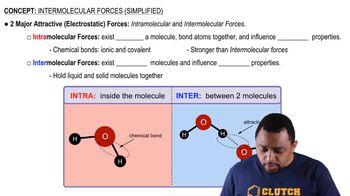
What is the main difference between intramolecular and intermolecular forces?
Intramolecular forces hold atoms together within a molecule, while intermolecular forces are attractions between separate molecules. Intramolecular forces are stronger and influence chemical properties, whereas intermolecular forces affect physical properties.
How does electronegativity contribute to intermolecular forces between water molecules?
Electronegativity differences cause oxygen in water to be partially negative and hydrogen to be partially positive. This polarity leads to attractive forces between water molecules.
What visual representation is commonly used to depict intermolecular forces between molecules?
Intermolecular forces are often shown as dotted lines between molecules. These lines symbolize attractions, not actual chemical bonds.
Why are ion-dipole forces considered the strongest type of intermolecular force?
Ion-dipole forces occur between ions and polar molecules, resulting in strong electrostatic attractions. This strength is greater than that of other intermolecular forces due to the full charges on ions.
What is meant by the term 'aqueous' when describing ions in solution?
Aqueous means that the ion is surrounded by water molecules in solution. This process is also called solvation.
Why can London dispersion forces be found in all types of compounds?
London dispersion forces arise from temporary dipoles that occur when molecules are in close proximity. Because all molecules can experience these momentary dipoles, dispersion forces are universally present.
What causes the temporary polarity that leads to London dispersion forces between nonpolar molecules?
Temporary polarity is caused by the close proximity of molecules, which induces slight, momentary dipoles. These induced dipoles create weak attractions between nonpolar molecules.
How does the polarity of a compound influence the type of intermolecular force present?
Polarity determines whether a molecule can participate in forces like dipole-dipole or hydrogen bonding. Nonpolar molecules primarily experience London dispersion forces, while polar molecules can have stronger interactions.