Pearson+ LogoPearson+ Logo
Back

Intro to Buffers quiz #1

Control buttons has been changed to "navigation" mode.
1/10
  • What is the primary role of pH buffers in a solution?

    The primary role of pH buffers is to resist drastic changes in pH by neutralizing added acids or bases, thereby maintaining pH stability.
  • What is the purpose of a buffer in chemical solutions?

    The purpose of a buffer is to maintain a stable pH in a solution by neutralizing small amounts of added acid or base.
  • How does a buffer function to maintain pH stability?

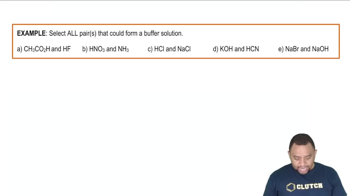
    A buffer functions by containing both a weak acid and its conjugate base (or vice versa), which react with added acids or bases to minimize changes in pH.
  • What is a buffer and what is it commonly used for in chemistry?

    A buffer is a solution containing a weak acid and its conjugate base (or a weak base and its conjugate acid) that is used to maintain a stable pH when small amounts of acid or base are added.
  • What type of chemical system could be used to buffer vinegar (acetic acid)?

    To buffer vinegar, which contains acetic acid (a weak acid), a solution containing acetic acid and its conjugate base, such as sodium acetate, can be used.
  • What happens to the pH of a buffer solution when a small amount of strong acid is added?

    The pH decreases slightly, but not drastically, because the buffer neutralizes the added acid. This resistance to large pH changes is a key property of buffers.
  • Why must the weak species be present in greater concentration than the strong species when making a buffer from a strong acid or base?

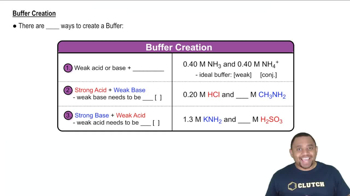
    The weak species must be in greater concentration to ensure it can effectively neutralize the added strong acid or base. This allows the buffer to maintain its pH-stabilizing properties.
  • What is the effect on buffer capacity when the concentrations of the buffer components are increased?

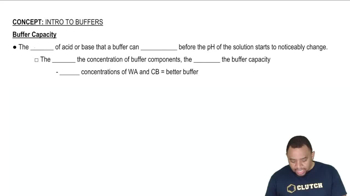
    Increasing the concentrations of the buffer components increases the buffer capacity. This means the buffer can neutralize more added acid or base before the pH changes significantly.
  • What is the maximum effective ratio of weak acid to conjugate base for a buffer to remain effective?

    A buffer remains effective as long as the ratio of weak acid to conjugate base is between 10:1 and 1:10. Ratios outside this range reduce the buffer's effectiveness.
  • How does the addition of a strong base affect the composition of a buffer containing hydrofluoric acid and sodium fluoride?

    The hydrofluoric acid reacts with the added strong base, producing water and increasing the amount of fluoride ion. This causes a slight increase in pH, but the buffer minimizes the change.