Back

Intro to Hydrocarbons quiz

Control buttons has been changed to "navigation" mode.
1/15
  • What elements make up hydrocarbons?

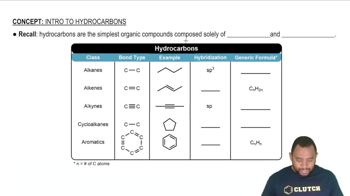
    Hydrocarbons are composed solely of carbon and hydrogen atoms.
  • What is the general formula for alkanes?

    The general formula for alkanes is CnH2n+2, where n is the number of carbon atoms.
  • How many bonds does each carbon atom form in an alkane?

    Each carbon atom in an alkane forms four bonds.
  • What type of hybridization do the carbons in alkanes have?

    Carbons in alkanes are sp3 hybridized.
  • What is the general formula for alkenes?

    The general formula for alkenes is CnH2n.
  • How does the number of hydrogens change when a double bond is introduced in a hydrocarbon?

    Introducing a double bond causes the molecule to lose two hydrogens compared to the corresponding alkane.
  • What is the hybridization of carbons involved in a double bond (alkene)?

    Carbons in a double bond (alkene) are sp2 hybridized.
  • What is the general formula for alkynes?

    The general formula for alkynes is CnH2n-2.
  • What is the hybridization of carbons in a triple bond (alkyne)?

    Carbons in a triple bond (alkyne) are sp hybridized.
  • What is the general formula for cycloalkanes?

    Cycloalkanes have the general formula CnH2n.
  • How does the formula for cycloalkanes compare to that of alkenes?

    Cycloalkanes and alkenes share the same general formula, CnH2n.
  • What is the formula for benzene, an aromatic hydrocarbon?

    Benzene has the formula C6H6.
  • What is the difference between saturated and unsaturated hydrocarbons?

    Saturated hydrocarbons have only single bonds and the maximum number of hydrogens, while unsaturated hydrocarbons have double or triple bonds and fewer hydrogens.
  • Can alkanes rotate freely around their carbon-carbon bonds?

    Yes, alkanes can rotate freely around their single carbon-carbon bonds.
  • Why can't alkenes and alkynes rotate freely around their multiple bonds?

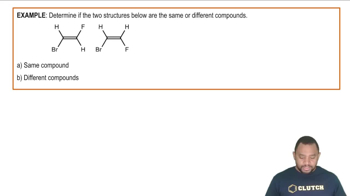
    Alkenes and alkynes cannot rotate freely around their double or triple bonds due to the rigidity of the π bonds.