Back

Ions quiz

Control buttons has been changed to "navigation" mode.
1/15
  • What is an ion?

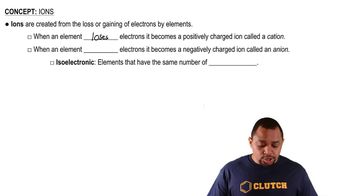
    An ion is an atom that has gained or lost electrons, resulting in a net electrical charge.
  • What happens to an atom when it loses electrons?

    When an atom loses electrons, it becomes a positively charged ion called a cation.
  • What is a cation?

    A cation is a positively charged ion formed when an atom loses electrons.
  • What happens to an atom when it gains electrons?

    When an atom gains electrons, it becomes a negatively charged ion called an anion.
  • What is an anion?

    An anion is a negatively charged ion formed when an atom gains electrons.
  • Does the atomic number change when an ion is formed?

    No, the atomic number, which is the number of protons, remains unchanged during ion formation.
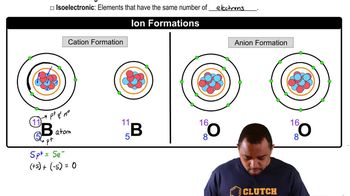
  • How does a neutral boron atom become a boron cation with a +3 charge?

    A neutral boron atom becomes a boron cation with a +3 charge by losing three electrons.
  • How does a neutral oxygen atom become an oxygen anion with a -2 charge?

    A neutral oxygen atom becomes an oxygen anion with a -2 charge by gaining two electrons.
  • What is the charge of a neutral atom?

    A neutral atom has no net charge because it has equal numbers of protons and electrons.
  • What does the term 'isoelectronic' mean?

    Isoelectronic refers to elements or ions that have the same number of electrons.
  • What is the relationship between protons and electrons in a neutral atom?

    In a neutral atom, the number of protons equals the number of electrons.
  • What subatomic particles change when an ion is formed?

    Only the number of electrons changes when an ion is formed; protons and neutrons remain the same.
  • How do you calculate the charge of an ion?

    The charge of an ion is calculated by subtracting the number of electrons from the number of protons.
  • What is the charge of a boron ion with 5 protons and 2 electrons?

    The charge is +3, because 5 protons minus 2 electrons equals +3.
  • What is the charge of an oxygen ion with 8 protons and 10 electrons?

    The charge is -2, because 8 protons minus 10 electrons equals -2.