Pearson+ LogoPearson+ Logo

Ions quiz #10 Flashcards

Ions quiz #10
Control buttons has been changed to "navigation" mode.
1/40
  • When forming a compound, sodium loses electrons. What ion does it form?

    Sodium forms Na+.
  • How many protons are in an ion with 86 electrons and a -1 charge?

    It has 85 protons (At-).
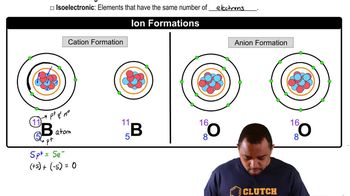
  • How does an atom become a positive or a negative ion?

    By losing electrons (positive) or gaining electrons (negative).
  • Which of the following has a positive charge?

    Cations, such as Na+, have a positive charge.
  • Which two particles would be attracted to each other?

    A cation and an anion would be attracted to each other.
  • What is the charge of a single chloride ion?

    A single chloride ion has a -1 charge.
  • What is the charge of the proton?

    A proton has a +1 charge.
  • What is a positive ion? What is a negative ion?

    A positive ion is a cation; a negative ion is an anion.
  • What is a positive ion?

    A positive ion is called a cation.
  • What are the two ions present in ocean water?

    Na+ and Cl- are the two main ions.
  • What are negatively or positively charged particles called?

    They are called ions.
  • What do we call it when an object has more protons than electrons?

    It is called a cation.
  • An atom that is ionized must have which of the following?

    An unequal number of protons and electrons.
  • What would be required for magnesium to form the ion Mg2+?

    Magnesium must lose two electrons.
  • What ion is formed when an atom of mercury (Hg) loses two electrons?

    Hg2+ is formed.
  • What could be done to change this carbide ion to a neutral carbon atom?

    Remove four electrons from the carbide ion (C4-).
  • What is the charge of a cation?

    A cation has a positive charge.
  • What is the net charge of an ion that has 11 protons?

    If it has 10 electrons, the charge is +1.
  • What is the difference between a cation and an anion?

    A cation is positive; an anion is negative.
  • What ion is formed when an atom of magnesium (Mg) loses two electrons?

    Mg2+ is formed.
  • Which of these ions is most likely to be leached from the soil?

    Nitrate (NO3-) is commonly leached from soil.
  • What would the name of S2- be?

    S2- is called the sulfide ion.
  • Which ions (with correct charges) are present in an aqueous solution of ZnCl2?

    Zn2+ and Cl- ions are present.
  • What can you say about the species XO- that is dissociated from HXO in solution?

    XO- is an anion.
  • When an atom is charged, what is it called?

    It is called an ion.
  • What ion is most closely associated with bases: ammonium, hydroxide, carbonate, or hydrogen?

    Hydroxide (OH-) is most closely associated with bases.
  • What is the charge of the metal in [Fe(NH3)2Br4]2–? Omit the + sign.

    The charge is 2.
  • What is the charge on chromium in [Cr(NH3)3Br3]?

    The charge on chromium is +3.
  • Which ions have ten electrons in the outermost subshell?

    Na+, F-, and Ne have ten electrons in the outermost shell.
  • What is the process whereby an ion is formed?

    Ionization is the process of forming ions.
  • What term refers to the separation of an atom or molecule into positive and negative ions?

    Ionization refers to this separation.
  • Aluminum is a group 3A metal. Which ion does Al typically form?

    Aluminum typically forms Al3+.
  • If my charge becomes 2+, what does that say about me?

    You are a cation with a +2 charge.
  • Which condition produces an anion?

    Gaining electrons produces an anion.
  • What occurs when a magnesium atom becomes a magnesium ion?

    It loses two electrons to become Mg2+.
  • What species is represented by the following information: p+ = 12, n = 14, e- = 10?

    Mg2+ ion with mass number 26.
  • How many electrons are in Rb+?

    Rb+ has 36 electrons.
  • How did this sodium atom get a positive (+1) charge?

    It lost one electron.
  • An atom or a molecule with either a positive or negative charge is referred to as a(n)?

    It is called an ion.
  • The net charge on an atom of a given element changes as ______ are added or removed.

    Electrons are added or removed.