Pearson+ LogoPearson+ Logo

Ions quiz #11 Flashcards

Ions quiz #11
Control buttons has been changed to "navigation" mode.
1/40
  • A hydrogen ion, formed during the dissociation of water, has a charge of which of the following?

    +1.
  • An atom or a molecule with either a positive or negative charge is called a(n)?

    It is called an ion.
  • A positively charged ion that makes a solution acidic is called?

    Hydronium ion (H3O+).
  • Determine the number of protons and electrons in N3-.

    N3- has 7 protons and 10 electrons.
  • A positively charged ion has one or more __.

    It has one or more fewer electrons than protons.
  • The oxygen has a ______ charge and the hydrogens a ________ charge in water.

    Oxygen has a partial negative charge; hydrogens have partial positive charges.
  • A positive ion forms when an atom ______.

    Loses electrons.
  • In order to have a positive charge, an atom must have ________.

    More protons than electrons.
  • A cation has a net charge, while an anion has a net charge.

    A cation has a positive net charge; an anion has a negative net charge.
  • What is the charge on the silver ion in AgMnO4?

    The charge on silver is +1.
  • After the transfer of the electron, sodium will form an ion with __________.

    A +1 charge.
  • A cation of +2 indicates that an element has?

    Lost two electrons.
  • When a Mg2+ ion becomes a Mg atom, the radius increases because the Mg2+ ion?

    Mg2+ has fewer electrons, so gaining electrons increases its radius.
  • An ion that consists of 7 protons, 6 neutrons, and 11 electrons has a net charge of ________.

    -4.
  • What is the charge of the metal in [Fe(NH3)2Br4]2–? Omit the + sign.

    2.
  • If N gains two electrons, which of the following elements would it be isoelectronic with?

    Fluorine (F-).
  • Will Ca gain electrons to form an ion?

    No, Ca loses electrons to form Ca2+.
  • What is the atomic number of the cation formed in the reaction in the illustration?

    The atomic number is the same as the neutral atom; it does not change.
  • If an unknown monatomic ion with a 3- charge has 10 electrons, what is the formula for that ion?

    N3-.
  • Ions are described as ________ if they have the same number of electrons.

    Isoelectronic.
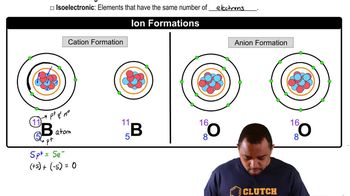
  • A cation is an element that _____ one or more electrons to form _____ ions.

    Loses; positive.
  • An atom or a molecule with either a positive or negative charge is referred to as a(n) .

    Ion.
  • An anion has a(n) _____ charge.

    Negative.
  • Sulfur readily forms the following monatomic ion:

    S2-.
  • An atom of magnesium has lost two electrons. It is known as a(n) ________.

    Mg2+ ion (cation).
  • Sodium is much more apt to exist as a cation than is chlorine. This is because ________.

    Sodium more easily loses an electron to form Na+.
  • When an atom that has no charge loses two electrons, it becomes a?

    A cation with a +2 charge.
  • A magnesium ion is _____ than a sodium ion.

    Smaller, due to higher charge and similar electron configuration.
  • An anion always?

    Has more electrons than protons.
  • A sodium cation is _____ than a sodium atom.

    Smaller.
  • Atoms with the same number of protons but with different electrical charges _____.

    Are different ions of the same element.
  • When electrons are removed from the outermost shell of a calcium atom, the atom becomes?

    A Ca2+ cation.
  • To become positively charged, an atom must:

    Lose electrons.
  • What is the charge of nitrate?

    Nitrate (NO3-) has a -1 charge.
  • When electrons are lost, a _____ ion is formed. When electrons are gained, a _____ ion is formed.

    Cation; anion.
  • Nonmetallic elements form ions by _____ valence electrons to complete their outer shell.

    Gaining.
  • When electrons are lost, a _____ ion is formed.

    Cation.
  • When an atom loses an electron it becomes a?

    Cation.
  • What is the charge of aluminum?

    Aluminum forms Al3+ with a +3 charge.
  • An atom or group of bonded atoms that has a positive or negative charge is called a/an?

    Ion.