Kinetic Molecular Theory quiz #3 Flashcards

Kinetic Molecular Theory quiz #3
Control buttons has been changed to "navigation" mode.
1/13
  • Which of the following are part of kinetic-molecular theory? Check all that apply.

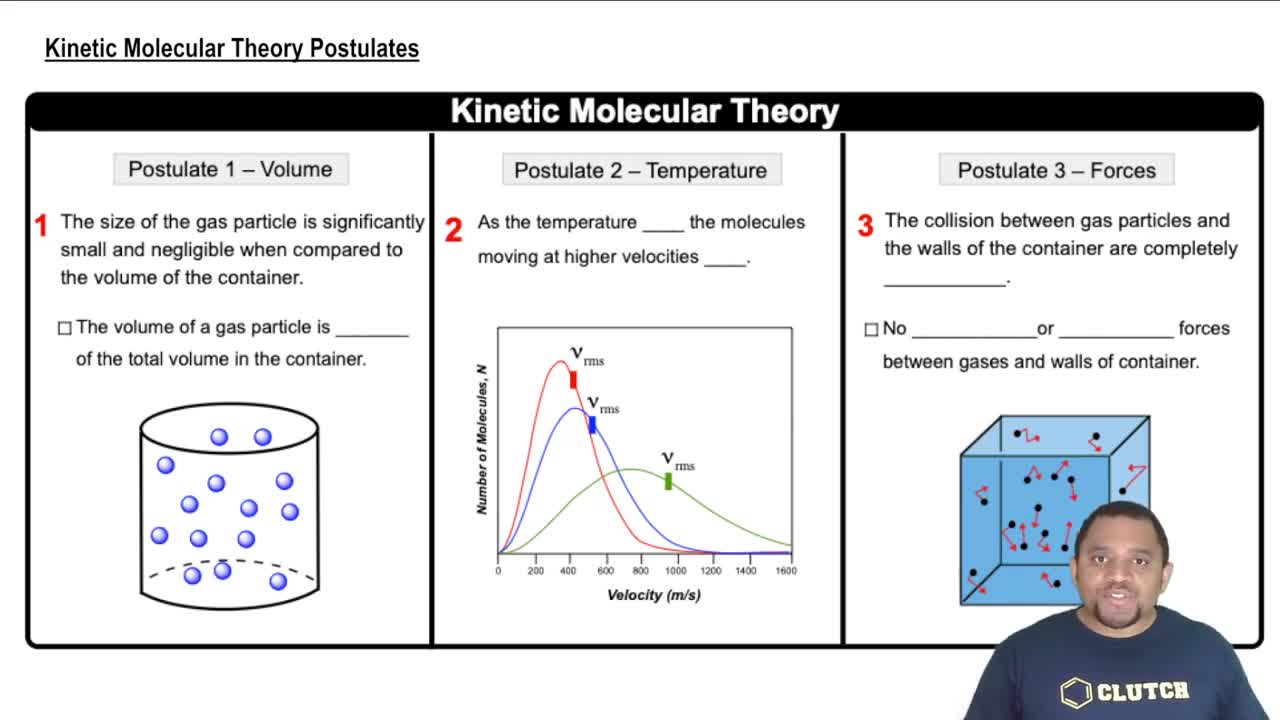
    Negligible particle volume, elastic collisions, and no intermolecular forces are part of the theory.
  • Which of the following gases has the highest average speed at 400K?

    The gas with the lowest molar mass has the highest average speed at 400K.
  • Which of these would have particles with the highest kinetic energy: ice, water, or water vapor?

    Water vapor has particles with the highest kinetic energy.
  • Which contains the particles that are vibrating fastest?

    The sample at the highest temperature contains the fastest vibrating particles.
  • In which of the following would the particles move most rapidly?

    Particles move most rapidly in the gas phase.
  • What will happen to the gas molecules in the container as thermal energy is applied?

    As thermal energy is applied, gas molecules move faster and their kinetic energy increases.
  • If enough heat is added to a gas, which of the following would most likely happen?

    If enough heat is added, the gas molecules will move faster and may expand or escape the container.
  • Driven by kinetic energy of the molecules, what property of gases is observed?

    Gases expand to fill their containers, driven by the kinetic energy of their molecules.
  • A measure of the average kinetic energy of the particles in a sample of matter is called what?

    Temperature is the measure of average kinetic energy of particles.
  • What state of matter has the most kinetic energy?

    The gas state has the most kinetic energy.
  • At a constant temperature, which of the gases will have the highest average kinetic energy?

    All gases have the same average kinetic energy at a constant temperature.
  • Which statement describes the particles of an ideal gas, based on the kinetic molecular theory?

    Ideal gas particles have negligible volume and no intermolecular forces.
  • For a constant temperature, which will have the greatest average speed?

    The substance with the lowest molar mass will have the greatest average speed at constant temperature.