Skip to main content
General Chemistry
My Course
Learn
Exam Prep
AI Tutor
Study Guides
Textbook Solutions
Flashcards
Explore
Try the app
My Course
Learn
Exam Prep
AI Tutor
Study Guides
Textbook Solutions
Flashcards
Explore
Try the app
Back
Kp and Kc quiz
You can tap to flip the card.
What does Kp represent in chemical equilibrium?
You can tap to flip the card.
👆
What does Kp represent in chemical equilibrium?
Kp is the equilibrium constant for reactions involving gases, measured in units of atmospheres.
Track progress
Control buttons has been changed to "navigation" mode.
1/15
Related flashcards
Related practice
Recommended videos
Kp and Kc definitions
Kp and Kc
15 Terms
Kp and Kc quiz #1
Kp and Kc
10 Terms
Kp and Kc
16. Chemical Equilibrium
5 problems
Topic
Jules
Using Hess's Law To Determine K
16. Chemical Equilibrium
3 problems
Topic
ErnestBlazevic
16. Chemical Equilibrium - Part 1 of 2
5 topics
11 problems
Chapter
Jules
16. Chemical Equilibrium - Part 2 of 2
5 topics
10 problems
Chapter
Jules
Guided course
02:06
Kp vs. Kc Formula
5183
views
58
rank
2
comments
Guided course
02:31
Kp vs Kc Relationship Example
3136
views
37
rank
1
comments
Guided course
02:18
Kp vs Kc Relationship
3646
views
32
rank
1
comments
Terms in this set (15)
Hide definitions
What does Kp represent in chemical equilibrium?
Kp is the equilibrium constant for reactions involving gases, measured in units of atmospheres.
What does Kc represent in chemical equilibrium?
Kc is the equilibrium constant for reactions involving aqueous solutions, measured in molarity (moles per liter).
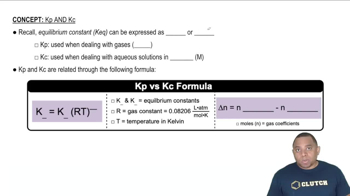
What is the formula that relates Kp and Kc?
The formula is Kp = Kc(RT)^(Δn), where R is the gas constant, T is temperature in Kelvin, and Δn is the change in moles of gas.
What is the value of the gas constant R used in the Kp and Kc relationship?
R equals 0.08206 L·atm/(mol·K).
How do you calculate Δn in the Kp and Kc equation?
Δn is calculated as the moles of gaseous products minus the moles of gaseous reactants.
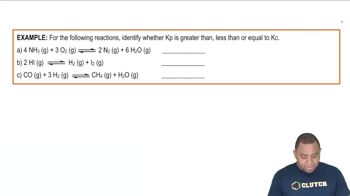
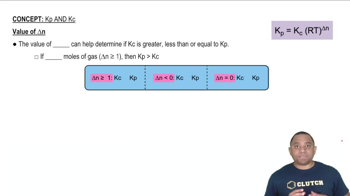
If Δn is positive, which is greater: Kp or Kc?
If Δn is positive, Kp is greater than Kc.
If Δn is negative, which is greater: Kc or Kp?
If Δn is negative, Kc is greater than Kp.
What happens to the relationship between Kp and Kc if Δn equals zero?
If Δn is zero, Kp equals Kc.
Why does Kp equal Kc when Δn is zero?
Because (RT)^0 equals 1, so Kp = Kc × 1, making them equal.
In the context of Kp and Kc, what does T represent?
T represents the temperature in Kelvin.
When should you use Kp instead of Kc?
Use Kp when dealing with gaseous reactions measured in atmospheres.
When should you use Kc instead of Kp?
Use Kc when dealing with reactions in aqueous solutions measured in molarity.
How can you determine Δn from a balanced chemical equation?
Count the total moles of gaseous products and subtract the total moles of gaseous reactants.
What does it mean if more moles of gas are produced than consumed in a reaction?
It means Δn is positive, so Kp will be greater than Kc.
How can you qualitatively predict the relationship between Kp and Kc without calculation?
By comparing the number of moles of gaseous products and reactants; more product moles means Kp > Kc, fewer means Kc > Kp, and equal means Kp = Kc.
 BackBack

 02:06
02:06