Back

Lattice Energy quiz

Control buttons has been changed to "navigation" mode.
1/15
  • What is lattice formation energy?

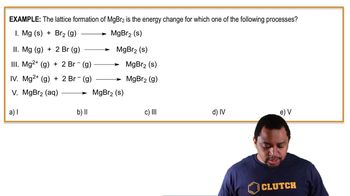
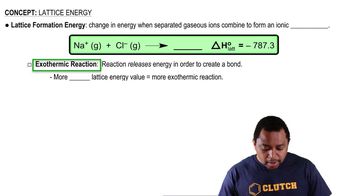
    Lattice formation energy is the change in energy when separated gaseous ions combine to form an ionic solid. This process is exothermic, releasing energy.
  • Why is lattice formation energy considered exothermic?

    It is exothermic because energy is released when new bonds are formed between ions. The enthalpy change (ΔH) is negative.
  • What are the reactants and products in lattice formation energy?

    The reactants are gaseous ions, and the product is a mole of an ionic solid. For example, Na⁺(g) and Cl⁻(g) combine to form NaCl(s).
  • What is lattice dissociation energy?

    Lattice dissociation energy is the change in energy when an ionic solid is broken into its gaseous ions. This process is endothermic, absorbing energy.
  • Why is lattice dissociation energy considered endothermic?

    It is endothermic because energy is absorbed to break the bonds in the ionic solid. The enthalpy change (ΔH) is positive.
  • What happens to the sign of ΔH in lattice formation versus dissociation?

    ΔH is negative for lattice formation (exothermic) and positive for lattice dissociation (endothermic).
  • How does the value of lattice energy relate to the exothermic or endothermic nature of a reaction?

    A more negative lattice energy means a more exothermic reaction, while a more positive value means a more endothermic reaction.
  • What is the simplified formula for lattice energy?

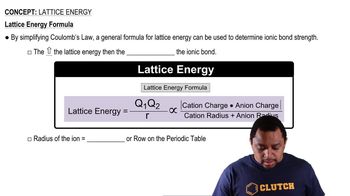
    Lattice energy equals the product of the absolute values of the cation and anion charges divided by the sum of their radii. It is derived from Coulomb's law.
  • What does 'r' represent in the lattice energy formula?

    'r' represents the sum of the radii of the cation and anion. It is related to their positions in the periodic table.
  • How does lattice energy affect ionic bond strength?

    Higher lattice energy means stronger ionic bonds. The ions are held more tightly together.
  • What physical properties are influenced by lattice energy?

    Lattice energy affects boiling point, melting point, and solubility. Higher lattice energy leads to higher boiling and melting points but lower solubility.
  • What is the relationship between lattice energy and solubility?

    There is an inverse relationship; higher lattice energy results in lower solubility. Stronger bonds make it harder for the solid to dissolve.
  • How does lattice energy relate to boiling and melting points?

    Higher lattice energy leads to higher boiling and melting points. Stronger ionic bonds require more energy to break.
  • How can the lattice energy formula be used to compare different ionic bonds?

    By plugging in the charges and radii of different ions, you can compare the strength of their ionic bonds. Higher charge and smaller radii increase lattice energy.
  • What is the direct relationship between lattice energy and ionic strength?

    As lattice energy increases, ionic bond strength also increases. This means ions are held together more tightly in the solid.