Back

Law of Multiple Proportions quiz

Control buttons has been changed to "navigation" mode.
1/15
  • Who formulated the Law of Multiple Proportions and in what year?

    John Dalton formulated the Law of Multiple Proportions in 1804.
  • What does the Law of Multiple Proportions state about the masses of elements in different compounds?

    It states that the masses of one element that combine with a fixed mass of another element are in ratios of small whole numbers.
  • What is the first step in applying the Law of Multiple Proportions to a set of compounds?

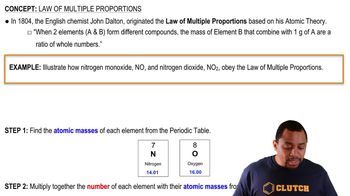
    The first step is to find the atomic masses of each element from the periodic table.
  • How do you determine the mass of each element in a compound for this law?

    Multiply the number of atoms of each element by its atomic mass.
  • What is the atomic mass of nitrogen used in the example?

    The atomic mass of nitrogen is 14.01 grams per mole.
  • What is the atomic mass of oxygen used in the example?

    The atomic mass of oxygen is 16.0 grams per mole.
  • How many oxygen atoms are in nitrogen dioxide (NO2)?

    There are 2 oxygen atoms in nitrogen dioxide (NO2).
  • What is the mass ratio of oxygen to nitrogen in nitrogen monoxide (NO)?

    The mass ratio is 16 grams of oxygen to 14.01 grams of nitrogen, or approximately 1.14.
  • What is the mass ratio of oxygen to nitrogen in nitrogen dioxide (NO2)?

    The mass ratio is 32 grams of oxygen to 14.01 grams of nitrogen, or approximately 2.28.
  • How do you confirm that two compounds obey the Law of Multiple Proportions?

    Divide the larger mass ratio by the smaller one; if the result is a whole number, the law is obeyed.
  • What is the result when you divide the mass ratio of NO2 by that of NO?

    The result is 2, which is a whole number.
  • Why does a whole number result confirm the Law of Multiple Proportions?

    A whole number result shows that the elements combine in simple, predictable ratios.
  • In the example, what is the ratio of oxygen atoms in NO2 compared to NO?

    NO2 has twice as many oxygen atoms as NO for the same amount of nitrogen.
  • What is the general relationship between elements in compounds according to this law?

    Elements can combine in different ways to form compounds, but always in simple whole number ratios.
  • What is the significance of the Law of Multiple Proportions in chemistry?

    It demonstrates the predictable and quantifiable ways elements combine to form compounds, supporting atomic theory.