Lewis Acids and Bases definitions Flashcards

Lewis Acids and Bases definitions
Control buttons has been changed to "navigation" mode.
1/15
  • Lewis Acid
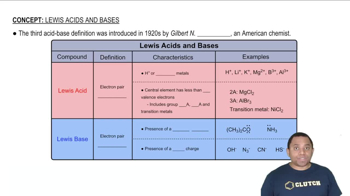
    An entity that accepts an electron pair, often a positively charged ion or a molecule with less than eight valence electrons.
  • Lewis Base
    A substance that donates an electron pair, typically characterized by a lone pair or a negative charge.
  • Electron Pair Acceptor
    A characteristic of Lewis acids, involving the acceptance of an electron pair to form a bond.
  • Electron Pair Donor
    A feature of Lewis bases, involving the donation of an electron pair to form a bond.
  • Adduct
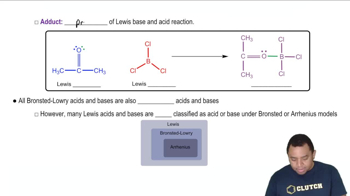
    The product of a Lewis acid-base reaction, formed by the combination of the acid and base.
  • Octet Rule
    A principle stating that atoms tend to bond in a way that gives them eight valence electrons.
  • Valence Electrons
    Electrons in the outermost shell of an atom, crucial for forming chemical bonds.
  • Transition Metals
    Elements that can accept electron pairs due to their d orbitals, often acting as Lewis acids.
  • Lone Pair
    A pair of valence electrons not involved in bonding, often found in Lewis bases.
  • Positive Charge
    An indicator of a Lewis acid, often seen in metal ions or H+ ions.
  • Negative Charge
    An indicator of a Lewis base, suggesting an excess of electrons available for donation.
  • Boron
    A group 3A element that can act as a Lewis acid due to having only six valence electrons.
  • Magnesium Chloride
    A compound where magnesium acts as a Lewis acid due to its electron deficiency.
  • Aluminum Bromide
    A compound where aluminum acts as a Lewis acid, having fewer than eight valence electrons.
  • Acetone
    A molecule that can act as a Lewis base by donating a lone pair of electrons.