Back

Lewis Dot Structures: Ions quiz

Control buttons has been changed to "navigation" mode.
1/15
  • What is the difference between a cation and an anion in terms of electrons?

    A cation has lost electrons and is positively charged, while an anion has gained electrons and is negatively charged.
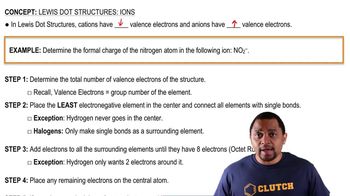
  • How does the charge of an ion affect the number of valence electrons in its Lewis dot structure?

    A positive charge (cation) means fewer valence electrons, and a negative charge (anion) means more valence electrons.
  • What is the first step in drawing a Lewis dot structure for an ion?

    The first step is to determine the total number of valence electrons in the structure.
  • How do you calculate the total number of valence electrons for NO2-?

    Add the valence electrons from nitrogen (5), two oxygens (12), and one extra electron for the negative charge, totaling 18.
  • Which element is placed in the center when drawing the Lewis dot structure for NO2-?

    Nitrogen is placed in the center because it is less electronegative than oxygen.
  • What is the rule for placing hydrogen and halogens in Lewis dot structures?

    Hydrogen never goes in the center, and halogens only make single bonds as surrounding elements.
  • How many valence electrons are used when connecting the central atom to surrounding atoms with single bonds in NO2-?

    Four valence electrons are used, since each single bond uses two electrons.
  • What is the octet rule in the context of Lewis dot structures?

    The octet rule states that atoms should have eight electrons around them to be stable, except for hydrogen which needs only two.
  • After distributing electrons to the surrounding atoms, where are any remaining electrons placed?

    Any remaining electrons are placed on the central atom.
  • What should you do if the central atom does not have an octet after placing all electrons?

    Form double or triple bonds between the central atom and surrounding atoms to fulfill the octet rule.
  • How do you calculate the formal charge of an atom in a Lewis dot structure?

    Subtract the number of bonds and nonbonding electrons from the group number of the element.
  • What is the formal charge of nitrogen in the nitrite ion (NO2-)?

    The formal charge of nitrogen is zero.
  • How is the Lewis dot structure of an ion indicated?

    The structure is enclosed in brackets with the ion's charge shown outside in the top right corner.
  • Why is it important to check formal charges when drawing Lewis dot structures?

    Checking formal charges helps verify the correctness and stability of the structure.
  • What is the total number of valence electrons used in the Lewis dot structure for NO2- before placing remaining electrons on the central atom?

    Sixteen valence electrons are used after distributing electrons to the oxygens, leaving two for the central atom.