What is a solution equilibrium in the context of aqueous solutions?
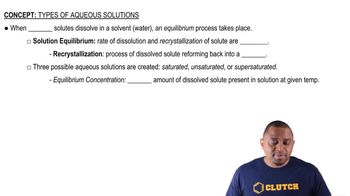
Solution equilibrium occurs when the rate of dissolution of solute equals the rate of recrystallization, resulting in a stable concentration of dissolved solute.
What does dissolution mean in aqueous solutions?
Dissolution is the process where a solid solute breaks up into ions and becomes dispersed in the solvent.
What is recrystallization in a solution?
Recrystallization is the process where dissolved solute reforms back into a solid from the solution.
How is equilibrium concentration defined in solutions?
Equilibrium concentration is the maximum amount of solute that can be dissolved in a solvent at a given temperature.
What are the three types of aqueous solutions?
The three types are saturated, unsaturated, and supersaturated solutions.
What characterizes a saturated solution?
A saturated solution contains the maximum amount of dissolved solute and has reached equilibrium concentration.
What is an unsaturated solution?
An unsaturated solution has less than the equilibrium concentration of solute and can dissolve more solute.
What defines a supersaturated solution?
A supersaturated solution contains more solute than the equilibrium concentration and is unstable unless conditions are changed.
Are saturated and unsaturated solutions stable or unstable?
Both saturated and unsaturated solutions are stable under normal conditions.
Is a supersaturated solution stable or unstable?
A supersaturated solution is unstable and may require external changes, like heating, to form.
How can you create a supersaturated solution?
A supersaturated solution can be created by increasing the temperature to dissolve more solute than the equilibrium concentration allows.
What happens if you add more solute to a saturated solution?
No more solute will dissolve; any extra will remain as solid because the solution has reached its equilibrium concentration.
What happens if you add more solute to an unsaturated solution?
The additional solute will dissolve until the solution reaches its equilibrium concentration.
What visual change might indicate a supersaturated solution compared to a saturated one?
A supersaturated solution may appear more intensely colored, indicating more solute is dissolved than in a saturated solution.
Why is understanding solution types important in chemistry?
Understanding solution types helps predict solubility behaviors and prepare solutions with desired concentrations.
 Back
Back
 01:49
01:49