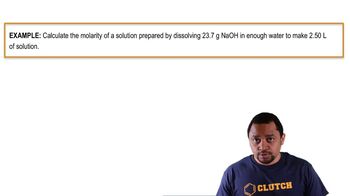
What is the concentration of lithium ions in 0.400 M Li2HPO4?
Li2HPO4 gives 2 Li+ per formula unit. [Li+] = 0.400 M × 2 = 0.800 M.
An NaOH solution contains 1.90 mol of NaOH, and its concentration is 0.555 M. What is its volume?
Volume = 1.90 mol / 0.555 M = 3.42 L.
How many moles of solute is added to a solution?
The number of moles added is calculated by dividing the mass of solute by its molar mass.
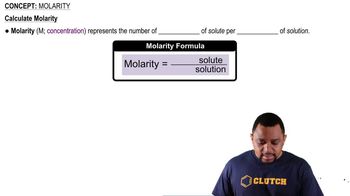
The molarity (M) of a solution refers to what?
It refers to the number of moles of solute per liter of solution.
How is molarity used as a conversion factor in chemical calculations?
Molarity connects moles of solute and liters of solution, allowing you to convert between these units in calculations.
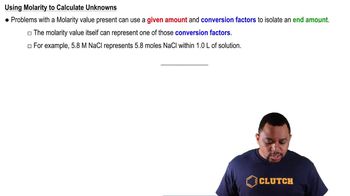
What does a solution labeled as 5.8 M NaCl indicate about its composition?
It means there are 5.8 moles of NaCl dissolved in every 1 liter of the solution.
Why is it important to understand dimensional analysis when working with molarity problems?
Dimensional analysis helps you use molarity as a conversion factor to solve for unknown quantities in solution calculations.
What is the difference between concentration and molarity as described in the lesson?
Concentration is a general term for the amount of solute in solution, while molarity specifically measures moles of solute per liter of solution.
What symbol is commonly used to represent molarity in equations?
Molarity is represented by a capital 'M' in equations.
How can you express the molarity of a solution as a fraction for use in calculations?
You can write molarity as moles of solute divided by liters of solution, such as 5.8 moles/1 liter for a 5.8 M solution.
What does molarity measure in chemistry?
Molarity measures the number of moles of solute per liter of solution, indicating the concentration of a solution.
What is the formula for calculating molarity?
Molarity (M) is calculated using the formula: M = moles of solute / liters of solution.
What are the units used to express molarity?
Molarity is expressed in moles per liter (mol/L).
What does the molarity of a solution indicate about its composition?
The molarity of a solution indicates how many moles of solute are present in one liter of solution.
How is molarity used as a conversion factor in chemical calculations?
Molarity can be used as a conversion factor to relate moles of solute to volume of solution, allowing conversion between these quantities in calculations.
What is the symbol commonly used to represent molarity?
Molarity is commonly represented by a capital 'M'.
In chemistry, what does the term 'concentration' refer to when discussing solutions?
Concentration refers to the amount of solute present in a given amount of solution, with molarity being a specific measure of concentration.
If a solution is described as 5.8 M sodium chloride, what does this mean?
It means the solution contains 5.8 moles of sodium chloride (NaCl) in every one liter of solution.
Which unit is commonly used to express the concentration of a solution in terms of molarity?
The unit commonly used is moles per liter (mol/L).
How can molarity help in determining unknown quantities in a chemical solution?
By using the molarity formula and conversion factors, you can calculate unknown amounts of solute or solution volume in chemical problems.
What does it mean for a solution to be more concentrated in terms of molarity?
A more concentrated solution has a higher molarity, meaning it contains more moles of solute per liter of solution.