Mole Concept quiz #1 Flashcards

Mole Concept quiz #1
Control buttons has been changed to "navigation" mode.
1/40
  • Magnesium and iron are metallic elements. How does a mole of magnesium compare with a mole of iron?

    A mole of magnesium contains the same number of atoms as a mole of iron (6.022×10^23 atoms), but their masses differ according to their molar masses.
  • Which value gives the number of particles in 1 mol of a substance?

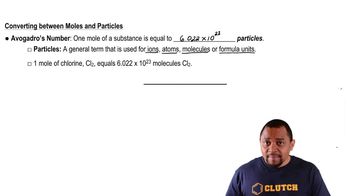
    Avogadro's number, 6.022×10^23, gives the number of particles in 1 mole.
  • How are a mole and a dozen similar?

    Both are counting units; a dozen is 12 items, while a mole is 6.022×10^23 particles.
  • What is the relationship between a mole and Avogadro’s number?

    One mole contains exactly Avogadro's number (6.022×10^23) of particles.
  • How many moles are in 23.4 g of CaCl2?

    Moles = 23.4 g ÷ molar mass of CaCl2 (110.98 g/mol) ≈ 0.211 moles.
  • How many particles are in one mole?

    One mole contains 6.022×10^23 particles.
  • Which is the number of carbon atoms in exactly 12 g of pure carbon-12?

    6.022×10^23 carbon atoms.
  • What is the number of moles present? (mol)

    The number of moles is calculated by dividing the given mass by the molar mass of the substance.
  • What is a mole in chemistry terms?

    A mole is the amount of substance containing 6.022×10^23 particles, equal to the number of atoms in 12 g of carbon-12.
  • How many moles of Cl are in one mole of CaCl2?

    There are 2 moles of Cl atoms in 1 mole of CaCl2.
  • Which proportionality applies to Avogadro’s law?

    Volume is directly proportional to the number of moles at constant temperature and pressure.
  • How many moles of HCl are there in 75.0 mL of 0.150 M HCl?

    Moles = 0.075 L × 0.150 mol/L = 0.01125 mol.
  • How many atoms are in one mole of carbon?

    6.022×10^23 atoms.
  • If you have a mole of carbon atoms, how many atoms do you have?

    You have 6.022×10^23 carbon atoms.
  • How many moles of water are in a given sample?

    Divide the mass of water by its molar mass (18.02 g/mol) to find the number of moles.
  • How many atoms are in a 24 g sample of carbon?

    24 g ÷ 12.01 g/mol = 2 moles; 2 × 6.022×10^23 = 1.204×10^24 atoms.
  • How many Mg ions are present in 3.00 moles of MgCl2?

    3.00 moles of MgCl2 contain 3.00 moles of Mg^2+ ions.
  • How many moles of K2SO4 are in 15.0 g of K2SO4?

    Moles = 15.0 g ÷ 174.26 g/mol ≈ 0.0861 moles.
  • How many things are in a mole?

    A mole contains 6.022×10^23 things (particles).
  • Avogadro's law states that at a given temperature and pressure, what is true?

    Equal volumes of gases contain equal numbers of moles (particles).
  • A mole is defined as the number of atoms in an exact mass of which isotope?

    Carbon-12.
  • Which of the following contains the most moles of atoms?

    The sample with the greatest number of atoms per given mass or volume contains the most moles.
  • How many atoms are in 1 mole?

    6.022×10^23 atoms.
  • How many molecules of water are in 18.01 g (one mole) of water?

    6.022×10^23 molecules.
  • One mole of particles of any substance contains how many particles?

    6.022×10^23 particles.
  • How many moles of KNO3 are in 500.0 mL of 2.0 M KNO3?

    Moles = 0.500 L × 2.0 mol/L = 1.0 mol.
  • What does a mole measure?

    A mole measures the amount of substance, specifically 6.022×10^23 particles.
  • If there are 12 × 10^23 oxygens in a sample of water, how many moles of oxygen atoms are present?

    12 × 10^23 ÷ 6.022×10^23 ≈ 1.99 moles.
  • Approximately how many atoms of carbon are present in a 120 gram sample of carbon?

    120 g ÷ 12.01 g/mol = 9.99 mol; 9.99 × 6.022×10^23 ≈ 6.02×10^24 atoms.
  • Approximately how many particles are in 2 moles?

    2 × 6.022×10^23 = 1.204×10^24 particles.
  • How many hydrogen atoms are in 2 moles of H2O?

    Each H2O has 2 H atoms: 2 moles × 2 × 6.022×10^23 = 2.41×10^24 H atoms.
  • How many atoms are in 1.50 moles of Hg?

    1.50 × 6.022×10^23 = 9.03×10^23 atoms.
  • What is the total number of moles of NaCl(s) needed to make 3.0 liters of a 2.0 M NaCl solution?

    Moles = 3.0 L × 2.0 mol/L = 6.0 mol.
  • Why is it useful to use moles to measure chemical quantities?

    Moles allow chemists to count large numbers of particles and relate mass to number of particles.
  • How many moles of iron (Fe) are in 279 g of iron?

    279 g ÷ 55.85 g/mol ≈ 5.00 moles.
  • How many carbon atoms are present in a mole of 12C?

    6.022×10^23 carbon atoms.
  • What is the mole ratio of H to N in the ammonia molecule?

    3:1 (3 H atoms for every 1 N atom in NH3).
  • Why is the mole an important unit to chemists?

    It allows chemists to relate mass, number of particles, and volume in chemical reactions.
  • Which value approximately represents the number of atoms in one mole of gold?

    6.022×10^23 atoms.
  • Why do we want to use the concept of moles?

    To count and relate large numbers of atoms, molecules, or ions in chemical reactions.