Mole Concept quiz #2 Flashcards

Mole Concept quiz #2
Control buttons has been changed to "navigation" mode.
1/40
  • How many moles of hydrogen atoms are present in 2.0 moles of ammonia (NH3)?

    2.0 moles NH3 × 3 H per NH3 = 6.0 moles H atoms.
  • Which one of the following contains the most moles of hydrogen atoms?

    The sample with the greatest number of hydrogen atoms per mole or mass.
  • How many molecules are in 4 moles of NH3?

    4 × 6.022×10^23 = 2.41×10^24 molecules.
  • How many moles of copper are there in the copper sample shown?

    Divide the sample's mass by copper's molar mass (63.55 g/mol) to find moles.
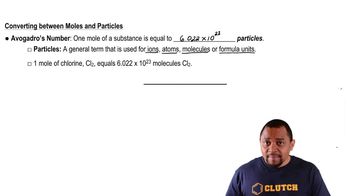
  • What does Avogadro's number represent?

    The number of particles in one mole: 6.022×10^23.
  • How many atoms are in 1.2 mol of carbon?

    1.2 × 6.022×10^23 = 7.23×10^23 atoms.
  • The chemical standard for the quantity of a mole is based on which substance?

    Carbon-12.
  • How many moles of carbon atoms are in 1 mole of carbon dioxide?

    1 mole of CO2 contains 1 mole of carbon atoms.
  • In what field of science do we most often use the mole?

    Chemistry.
  • How many atoms are in one mole?

    6.022×10^23 atoms.
  • Which sample contains a total of 9.0 × 10^23 atoms?

    A sample containing 1.5 moles of atoms (1.5 × 6.022×10^23 ≈ 9.0×10^23).
  • How many molecules of nitrogen monoxide are in a 22.5 gram sample?

    Moles = 22.5 g ÷ 30.01 g/mol ≈ 0.75 mol; molecules = 0.75 × 6.022×10^23 ≈ 4.52×10^23.
  • How many moles of C are in 1.22 moles of C6H12O6?

    1.22 moles × 6 = 7.32 moles of C atoms.
  • How many molecules are there in 4.00 moles of glucose?

    4.00 × 6.022×10^23 = 2.41×10^24 molecules.
  • Why do we use the mole?

    To count and relate large numbers of particles in chemical reactions.
  • How many atoms are in 1 mole of carbon?

    6.022×10^23 atoms.
  • How many moles are in 25.5g of silver?

    25.5 g ÷ 107.87 g/mol ≈ 0.236 moles.
  • How many grams of carbon-12 are there in 1 mole?

    12 grams.
  • How many atoms of gold (Au) are in 4 moles of gold?

    4 × 6.022×10^23 = 2.41×10^24 atoms.
  • What is the numerical value of a mole for atoms or molecules?

    6.022×10^23.
  • What is Avogadro's number?

    6.022×10^23.
  • How many atoms are in three moles of carbon?

    3 × 6.022×10^23 = 1.81×10^24 atoms.
  • How many C atoms are in 5.50 g of C?

    5.50 g ÷ 12.01 g/mol ≈ 0.458 mol; 0.458 × 6.022×10^23 ≈ 2.76×10^23 atoms.
  • How many molecules are in 2.5 mol of NaCl?

    2.5 × 6.022×10^23 = 1.51×10^24 formula units.
  • A mole is a unit of measurement. What is a mole used to count in chemistry?

    A mole is used to count atoms, molecules, ions, or formula units.
  • How many atoms of nitrogen are in 10 g of NH4NO3?

    Moles = 10 g ÷ 80.04 g/mol ≈ 0.125 mol; each mole has 2 N atoms: 0.125 × 2 × 6.022×10^23 ≈ 1.50×10^23 atoms.
  • What is the mass of 6.02 × 10^23 atoms of carbon-12?

    12 grams.
  • How many molecules of water are in 2.7 moles of water?

    2.7 × 6.022×10^23 = 1.63×10^24 molecules.
  • How many atoms are in 1.50 moles of fluorine gas?

    1.50 moles F2 × 2 atoms per molecule × 6.022×10^23 = 1.80×10^24 atoms.
  • How many atoms make up one mole?

    6.022×10^23 atoms.
  • How many atoms are there in one mole of carbon?

    6.022×10^23 atoms.
  • How many Mg atoms are found in 1.00 mole of Mg?

    6.022×10^23 atoms.
  • What is the total number of atoms contained in a 1.00-mole sample of helium?

    6.022×10^23 atoms.
  • How many NaCl formula units does it contain?

    One mole contains 6.022×10^23 formula units.
  • Which of the following represents the sample of N2 that has the greatest mass?

    The sample with the largest number of moles has the greatest mass.
  • What is the total number of atoms in a 30. gram sample of neon?

    30 g ÷ 20.18 g/mol ≈ 1.49 mol; 1.49 × 6.022×10^23 ≈ 8.97×10^23 atoms.
  • How many carbon atoms are present in 1.00 mole of methane?

    1.00 mole of CH4 contains 1.00 mole of carbon atoms: 6.022×10^23 atoms.
  • Why do chemists use the mole as a counting unit?

    Because it allows them to count and relate large numbers of tiny particles efficiently.
  • How many moles does 10.0 mg of CO represent?

    10.0 mg = 0.010 g; moles = 0.010 g ÷ 28.01 g/mol ≈ 0.000357 moles.
  • How many aluminum atoms are in 3.78 g of aluminum?

    3.78 g ÷ 26.98 g/mol ≈ 0.140 mol; 0.140 × 6.022×10^23 ≈ 8.43×10^22 atoms.