What is the approximate mole fraction of argon (Ar) in Earth's atmosphere?
The approximate mole fraction of argon (Ar) in Earth's atmosphere is about 0.009, or 0.9%. This means that for every 1 mole of air, there are roughly 0.009 moles of argon.
What variable is commonly used to represent mole fraction in chemistry?
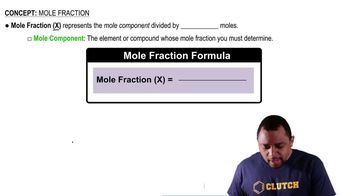
The variable 'X' is commonly used to represent mole fraction in chemistry.
How is the mole fraction of a component in a mixture calculated?
The mole fraction is calculated by dividing the moles of the component by the total moles in the mixture.
Is mole fraction a dimensionless quantity, and why?
Yes, mole fraction is dimensionless because it is a ratio of moles to moles, so the units cancel out.
Why is mole fraction useful for comparing concentrations in different mixtures?
Mole fraction is useful because it allows comparison without units, making it easier to evaluate concentrations across different mixtures.
What does the term 'mole component' refer to in the context of mole fraction?
The 'mole component' refers to the number of moles of the specific element or compound whose mole fraction is being determined.
How can mole fraction help predict solution properties like boiling point elevation?
Mole fraction helps predict solution properties because it quantifies the concentration of solute, which affects phenomena like boiling point elevation.
What is the general formula for mole fraction?
The general formula for mole fraction is X = (moles of component) / (total moles in the mixture).
Does calculating mole fraction require knowledge of the total moles in a mixture?
Yes, calculating mole fraction requires knowing both the moles of the component and the total moles in the mixture.
Can mole fraction be used for both elements and compounds in a mixture?
Yes, mole fraction can be used to express the concentration of either elements or compounds within a mixture.