Back

Molecular Polarity quiz #1

Control buttons has been changed to "navigation" mode.
1/38
  • What explains the negative charge on the oxygen atom within the water molecule?

    Oxygen is more electronegative than hydrogen, so it attracts shared electrons more strongly, resulting in a partial negative charge.
  • Which end of the water molecule attracts most of the electrons and acts negative?

    The oxygen end of the water molecule attracts most of the electrons and acts negative.
  • What does it mean when we say that a molecule is polar?

    A polar molecule has an uneven distribution of electrons, resulting in regions of partial positive and negative charge.
  • What characteristic makes a molecule polar?

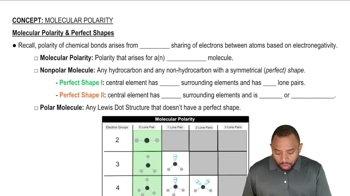
    A molecule that does not have a perfect shape and has an uneven electron distribution is polar.
  • Which atom in the Br-F molecule has a partial negative charge?

    The fluorine atom has a partial negative charge due to its higher electronegativity.
  • Which statement describes the charge distribution and the polarity of a CH4 molecule?

    CH4 has a symmetrical tetrahedral shape with identical surrounding atoms, resulting in a nonpolar molecule with even charge distribution.
  • Which side of the water molecule is facing the chloride ion?

    The hydrogen side (positive end) of the water molecule faces the chloride ion (negative ion).
  • Is CCl4 polar or nonpolar?

    CCl4 is nonpolar because it has a perfect tetrahedral shape with identical surrounding atoms and no lone pairs.
  • Is NH3 polar or nonpolar?

    NH3 is polar because the central nitrogen atom has a lone pair, resulting in an uneven electron distribution.
  • Water is polar. What does that mean?

    Water has an uneven distribution of electrons, with a partial negative charge on oxygen and partial positive charges on hydrogens.
  • What type of bonds do molecules with atoms of different electronegativities contain?

    Molecules with atoms of different electronegativities contain polar covalent bonds.
  • Which molecule is polar?

    A molecule that does not have a perfect shape and has an uneven electron distribution is polar.
  • Is SCl2 polar or nonpolar?

    SCl2 is polar because the central sulfur atom has lone pairs, resulting in an uneven electron distribution.
  • Which molecule will have a net dipole?

    A molecule with an uneven electron distribution and no perfect shape will have a net dipole.
  • Which molecule has polar bonds but is nonpolar due to its linear, symmetrical shape?

    CO2 has polar bonds but is nonpolar due to its linear, symmetrical shape.
  • What characteristic do nonpolar molecules like CH4 and CCl4 share?

    Molecules with perfect shapes and identical surrounding atoms, such as CH4 and CCl4, are nonpolar.
  • Which term describes molecules that attract water or dissolve in it because of their polar nature?

    Hydrophilic describes molecules that attract water or dissolve in it due to their polarity.
  • Is a molecule of hydrogen chloride (HCl) polar or nonpolar?

    HCl is polar because hydrogen and chlorine have different electronegativities, resulting in uneven electron distribution.
  • Is NH3 polar?

    Yes, NH3 is polar due to the lone pair on nitrogen and its trigonal pyramidal shape.
  • What is the reason that a water molecule is polar?

    Water is polar because oxygen is more electronegative than hydrogen and the molecule has a bent shape.
  • Which structure represents a nonpolar molecule?

    A structure with a perfect shape and identical surrounding atoms, such as tetrahedral CH4, represents a nonpolar molecule.
  • Which end of the water molecule would be attracted to a sodium ion in solution?

    The oxygen end (negative side) of the water molecule would be attracted to a sodium ion (positive ion).
  • What molecular features cause a molecule to be polar?

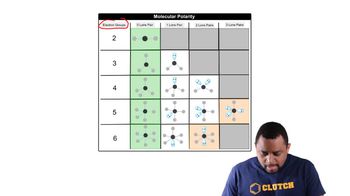
    A molecule with an imperfect shape or lone pairs on the central atom is polar.
  • What type of molecule has a net dipole moment of zero?

    A molecule with a perfect shape and identical surrounding atoms, such as CO2, has a net dipole moment of zero.
  • What characteristic makes a molecule nonpolar?

    Molecules with perfect shapes and identical surrounding atoms, such as BF3 and CCl4, are nonpolar.
  • Is GeH4 polar or nonpolar?

    GeH4 is nonpolar because it has a perfect tetrahedral shape with identical surrounding atoms.
  • Is NH3 polar?

    Yes, NH3 is polar due to its lone pair and trigonal pyramidal shape.
  • Why is BeF2 a nonpolar molecule?

    BeF2 is nonpolar because it is linear with identical surrounding atoms and no lone pairs on the central atom.
  • Is CO2 polar?

    CO2 is nonpolar because it is linear and symmetrical, with identical surrounding atoms.
  • What makes water and acetone polar molecules?

    Both have uneven electron distribution due to differences in electronegativity and molecular geometry.
  • Which molecule contains polar covalent bonds but is nonpolar due to its shape?

    CCl4 contains polar covalent bonds but is nonpolar due to its perfect tetrahedral shape.
  • What makes molecules like NH3 and H2O polar?

    Molecules with lone pairs on the central atom or different surrounding atoms, such as NH3 and H2O, are polar.
  • Which molecule(s) contain(s) polar covalent bonds?

    Molecules with atoms of different electronegativities, such as HCl and H2O, contain polar covalent bonds.
  • A polar covalent bond is found in which of these compounds?

    A polar covalent bond is found in compounds with atoms of different electronegativities, such as HCl.
  • Is BF3 polar or nonpolar?

    BF3 is nonpolar because it has a perfect trigonal planar shape with identical surrounding atoms.
  • Which structural formula represents a polar molecule?

    A structural formula with lone pairs on the central atom or different surrounding atoms represents a polar molecule.
  • What is necessary for a molecule to be considered polar?

    A molecule must have an uneven electron distribution, often due to lone pairs or different surrounding atoms.
  • What type of molecules have no net dipole moment?

    Molecules with perfect shapes and identical surrounding atoms, such as CO2 and CCl4, have no net dipole moment.