What functional groups are present in a carboxylic acid?
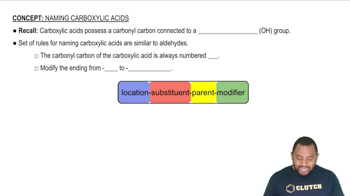
A carboxylic acid contains both a carbonyl group (C=O) and a hydroxyl group (OH). These groups are directly connected to the same carbon atom.
Which carbon is always assigned as carbon number one in carboxylic acid nomenclature?
The carbonyl carbon of the carboxylic acid is always assigned as carbon number one. This rule is similar to the naming of aldehydes.
How is the parent alkane name modified when naming a carboxylic acid?
The 'e' at the end of the parent alkane name is replaced with 'oic acid'. This change signifies the presence of the carboxylic acid functional group.
Why is it important to identify the locations of substituents when naming carboxylic acids?
Identifying substituent locations ensures the correct and unambiguous naming of the compound. It helps distinguish between different structural isomers.
What is the relationship between carboxylic acid and aldehyde naming conventions?
Both carboxylic acids and aldehydes assign the carbonyl carbon as carbon number one. This similarity simplifies the naming process for these functional groups.
What does the presence of a carboxylic acid group indicate about the parent chain in nomenclature?
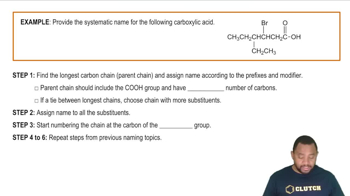
The parent chain must include the carbon of the carboxylic acid group. This ensures the functional group is properly represented in the compound's name.
What suffix is used to indicate a carboxylic acid in IUPAC nomenclature?
The suffix 'oic acid' is used in IUPAC nomenclature for carboxylic acids. It replaces the 'e' ending of the corresponding alkane.
How does the presence of substituents affect the naming of carboxylic acids?
Substituents must be named and their positions indicated relative to the carboxylic acid group. This provides a complete and systematic name for the compound.
What is the structural connection between the carbonyl and hydroxyl groups in a carboxylic acid?
In a carboxylic acid, the carbonyl carbon is directly bonded to the hydroxyl group. This unique arrangement defines the carboxylic acid functional group.