Nature of Energy quiz #3 Flashcards

Nature of Energy quiz #3
Control buttons has been changed to "navigation" mode.
1/40
  • Which of the following best explains energy transformation in hydrogen fuel cells?

    Chemical energy in hydrogen is converted to electrical energy in fuel cells.
  • What does the root 'therm' mean?

    'Therm' refers to heat.
  • Which best describes the energy change that takes place during deposition?

    Thermal energy is released as a gas changes directly to a solid.
  • How does adding energy to a solid affect the motion of the particles?

    Adding energy increases particle motion, possibly causing melting.
  • Which form of energy does a battery-powered flashlight receive as an input?

    A battery-powered flashlight receives chemical energy as input.
  • Heating up a solution of molecules will result in which of the following events to occur?

    Molecules will move faster and the temperature will increase.
  • Which of the following statements regarding energy is true?

    Energy can be transformed but is always conserved.
  • What kind of energy can be transferred?

    Both thermal and chemical energy can be transferred.
  • Which of these indicates that a liquid has transferred thermal energy to the air?

    Evaporation or cooling of the liquid indicates thermal energy transfer to air.
  • Which event would most likely occur if earth did not retain the heat from its formation?

    Earth would be much colder and unable to support life.
  • How are energy and mass connected during the formation of an atom?

    Energy and mass are related by E=mc²; mass can be converted to energy.
  • Where could convection currents form?

    Convection currents can form in fluids like air, water, or magma.
  • What's the easiest way to add energy to matter?

    Heating is the easiest way to add energy to matter.
  • Jon is a scientist researching the heat value of coal. Which heat measurement should he use?

    Jon should use joules or calories to measure the heat value of coal.
  • What is usually the initial source of chemical energy?

    Chemical energy originates from the bonds within molecules.
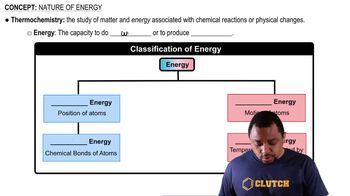
  • What is energy? Give an example of energy on a small scale.

    Energy is the capacity to do work or produce heat; an example is the motion of molecules in a gas.
  • Why does a hot water bottle feel warm?

    A hot water bottle feels warm because it transfers thermal energy to your skin.
  • What type of energy is associated with food?

    Food contains chemical energy.
  • Which molecule has the greatest chemical potential energy?

    Large, complex molecules with many bonds, like fats, have high chemical potential energy.
  • What form of energy causes water in the ocean to evaporate?

    Thermal energy from the sun causes ocean water to evaporate.
  • Which of the following occurs as soon as a heating thermostat is closed?

    Electrical energy flows, which is converted to thermal energy to heat the space.
  • Which of the following contains the most usable energy per kilogram?

    Fats contain the most usable energy per kilogram.
  • What happens to the energy stored in oil when you use it to heat your house?

    The chemical energy in oil is converted to thermal energy.
  • Why would a chemical incident create thermal harm?

    A chemical incident may release energy as heat, causing burns or thermal damage.
  • What is stored energy called?

    Stored energy is called potential energy.
  • What type of energy is created by breaking the bonds?

    Breaking bonds releases chemical energy, often as thermal energy.
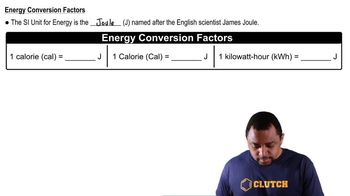
  • Which of the following items is not a common unit of energy?

    Degree Celsius is not a unit of energy.
  • Which of these is not currently a source of usable energy?

    Plastic waste is not a common source of usable energy.
  • The energy needed to create any type of weather comes from the ________.

    The sun provides the energy needed to create weather.
  • Liquid water's high specific heat is mainly a consequence of the

    Hydrogen bonding between water molecules gives water a high specific heat.
  • What substances yield the most energy?

    Fats and hydrocarbons yield the most energy per mass.
  • Which is greater in magnitude, the heat of fusion or the heat of vaporization of water?

    The heat of vaporization of water is greater than the heat of fusion.
  • Which would most likely cause an increase in the energy of water molecules in liquid water?

    Heating the water increases the energy of its molecules.
  • Water has a high heat of vaporization. What does this mean?

    It takes a lot of energy to convert water from liquid to gas.
  • _____ is the process by which heat and light reach from the sun to earth.

    Radiation is the process by which heat and light reach Earth from the sun.
  • Cooling of air expansion is called ________.

    Cooling of air expansion is called adiabatic cooling.
  • The movement of energy can be tracked by observing the changes the energy causes to matter.

    True; energy movement is observed by changes in temperature, state, or motion of matter.
  • Select the statement that correctly explains the source of the energy change in a chemical reaction.

    Energy change in a chemical reaction comes from breaking and forming chemical bonds.
  • Which form of energy changes in chemical reactions due to bonds breaking and forming?

    Chemical energy changes during chemical reactions.
  • Why does the product of each chemical reaction contain less energy than the starting substrate?

    Energy is released as heat or work, making products lower in energy than reactants.