Back

Neutron to Proton Ratio quiz

Control buttons has been changed to "navigation" mode.
1/15
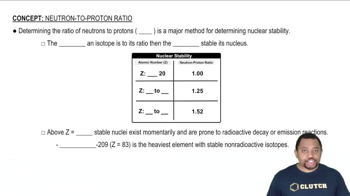
  • What is the ideal neutron to proton (N/Z) ratio for isotopes with atomic numbers less than or equal to 20?

    The ideal N/Z ratio is 1 for isotopes with atomic numbers ≤ 20.
  • What is the ideal neutron to proton ratio for isotopes with atomic numbers between 21 and 40?

    The ideal N/Z ratio is 1.25 for isotopes with atomic numbers from 21 to 40.
  • What is the ideal neutron to proton ratio for isotopes with atomic numbers between 41 and 83?

    The ideal N/Z ratio is 1.52 for isotopes with atomic numbers from 41 to 83.
  • What happens to the neutron to proton ratio as the atomic number increases?

    As the atomic number increases, the ideal neutron to proton ratio also increases.
  • What is the significance of an atomic number greater than 83 in terms of nuclear stability?

    Isotopes with atomic numbers greater than 83 are inherently unstable and prone to radioactive decay.
  • Name the heaviest element with stable, non-radioactive isotopes.

    Bismuth-209, with atomic number 83, is the heaviest element with stable, non-radioactive isotopes.
  • What types of radioactive decay can isotopes with atomic numbers greater than 83 undergo?

    They can undergo beta decay, alpha decay, positron emission, or electron capture.
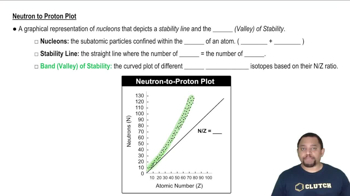
  • What are nucleons?

    Nucleons are the subatomic particles (protons and neutrons) found within the nucleus of an atom.
  • What does the stability line on a neutron to proton plot represent?

    The stability line represents where the number of neutrons equals the number of protons (N/Z = 1).
  • What is the band or valley of stability on a neutron to proton plot?

    It is the curved region where non-radioactive, stable isotopes fall according to their N/Z ratio.
  • What does it mean if an isotope falls within the band or valley of stability?

    It means the isotope is stable and non-radioactive.
  • What does it mean if an isotope falls outside the band or valley of stability?

    It means the isotope is unstable and likely to be radioactive.
  • How is the neutron to proton ratio used to assess nuclear stability?

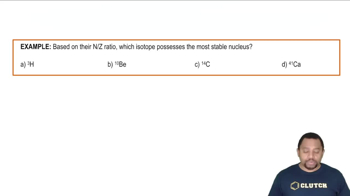
    The closer an isotope's N/Z ratio is to the ideal value for its atomic number, the more stable its nucleus.
  • What is the relationship between nucleons and the nucleus?

    Nucleons (protons and neutrons) are the particles that make up the nucleus of an atom.
  • Why do heavier elements require a higher neutron to proton ratio for stability?

    Heavier elements need more neutrons to offset the increasing repulsive forces between protons and maintain stability.