Skip to main content
General Chemistry
My Course
Learn
Exam Prep
AI Tutor
Study Guides
Textbook Solutions
Flashcards
Explore
Try the app
My Course
Learn
Exam Prep
AI Tutor
Study Guides
Textbook Solutions
Flashcards
Explore
Try the app
Back
Nitrogen Family Reactions quiz
You can tap to flip the card.
What is the common characteristic of all group 5A (nitrogen family) elements?
You can tap to flip the card.
👆
What is the common characteristic of all group 5A (nitrogen family) elements?
They all have five valence electrons in their s and p subshells.
Track progress
Control buttons has been changed to "navigation" mode.
1/15
Related flashcards
Related practice
Recommended videos
Nitrogen Family Reactions definitions
Nitrogen Family Reactions
15 Terms
Oxides, Peroxides, and Superoxides
23. Chemistry of the Nonmetals
3 problems
Topic
Jules
23. Chemistry of the Nonmetals - Part 1 of 2
5 topics
11 problems
Chapter
Jules
23. Chemistry of the Nonmetals - Part 2 of 2
6 topics
9 problems
Chapter
Jules
Guided course
02:45
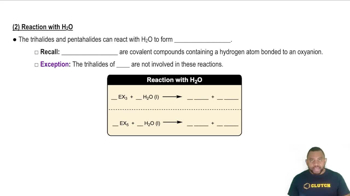
Reaction with H2O
608
views
Guided course
00:53
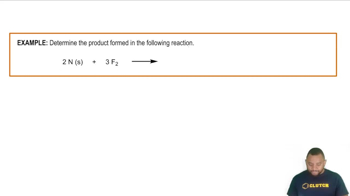
Nitrogen Family Reactions Example
708
views
Guided course
01:30
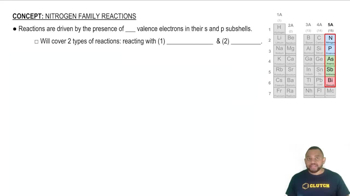
Nitrogen Family Reactions
655
views
Terms in this set (15)
Hide definitions
What is the common characteristic of all group 5A (nitrogen family) elements?
They all have five valence electrons in their s and p subshells.
Which types of elements are found in the nitrogen family (group 5A)?
The group includes nonmetals (nitrogen, phosphorus), metalloids (arsenic, antimony), and a metal (bismuth).
Why can't nitrogen form pentahalides?
Nitrogen is in period 2 and cannot have an expanded octet, so it cannot form pentahalides.
What compounds are formed when group 5A elements react with halogens?
They form trihalides (EX3) and, for some elements, pentahalides (EX5).
Which group 5A elements can form pentahalides?
Nonmetals and metalloids from period 3 and lower, such as phosphorus, arsenic, and antimony, can form pentahalides.
What is the general formula for a trihalide formed by a group 5A element?
The general formula is EX3, where E is the group 5A element and X is the halogen.
How many moles of diatomic halogen are needed to convert a group 5A element to a pentahalide?
A total of 4 moles of diatomic halogen are needed.
What is produced when a trihalide reacts with water?
A trihalide reacts with water to form an oxyacid with three oxygens and a hydrogen halide byproduct.
What is the formula for the oxyacid formed from a trihalide and water?
The formula is H3EO3, where E is the group 5A element.
What is the maximum number of oxygens found in oxyacids formed from pentahalides?
The maximum number is four oxygens.
What is the formula for the oxyacid formed from a pentahalide and water?
The formula is H3EO4, where E is the group 5A element.
What is always produced as a byproduct when trihalides or pentahalides react with water?
A hydrogen halide is always produced as a byproduct.
Why do pentahalides not form oxyacids with five oxygens?
Oxyacids do not go above four oxygens, so pentahalides form oxyacids with only four oxygens.
Which group 5A element's trihalides do NOT react with water to form oxyacids?
Nitrogen's trihalides do not participate in these reactions.
What is the relationship between the number of halogens in a trihalide and the number of oxygens in the resulting oxyacid?
Trihalides with three halogens produce oxyacids with three oxygens.
 BackBack
 02:45
02:45