Back

Nuclear Binding Energy quiz

Control buttons has been changed to "navigation" mode.
1/15
  • What is nuclear binding energy?

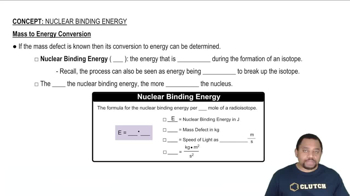
    Nuclear binding energy is the energy released when an isotope forms or the energy absorbed when it breaks apart.
  • What formula is used to calculate nuclear binding energy?

    The formula is E = m c^2, where E is energy, m is mass defect, and c is the speed of light.
  • What does a higher nuclear binding energy indicate about a nucleus?

    A higher nuclear binding energy means the nucleus is more stable.
  • What is the value of the speed of light used in the nuclear binding energy formula?

    The speed of light, c, is 3.00 x 10^8 meters per second.
  • In what units should the mass defect be when using the E = m c^2 formula?

    The mass defect should be in kilograms.
  • What are the typical units for nuclear binding energy?

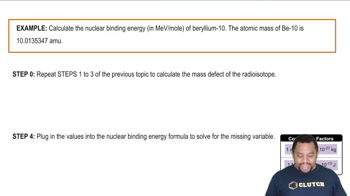
    Nuclear binding energy is typically measured in joules, but can also be converted to kilojoules or Mega electron volts.
  • How are mass defect and nuclear binding energy related?

    They are directly related through the formula E = m c^2; knowing one allows you to calculate the other.
  • What is the physical meaning of the mass defect in nuclear chemistry?

    The mass defect is the difference between the mass of the nucleus and the sum of the masses of its individual nucleons.
  • Why must the mass defect be in kilograms when calculating nuclear binding energy in joules?

    Because the joule is defined using kilograms, meters, and seconds, so mass must be in kilograms for unit consistency.
  • What happens to energy when an isotope forms?

    Energy is released when an isotope forms.
  • What happens to energy when an isotope breaks apart?

    Energy is absorbed when an isotope breaks apart.
  • Who is associated with the equation E = m c^2?

    Albert Einstein is associated with the equation E = m c^2.
  • Why is understanding nuclear binding energy important in nuclear chemistry?

    It helps explain isotope stability and the energy changes in nuclear reactions.
  • How can you convert nuclear binding energy from joules to other units?

    You can convert joules to kilojoules or Mega electron volts using appropriate conversion factors.
  • What does the process of mass-to-energy conversion explain in nuclear reactions?

    It explains how mass lost (mass defect) is converted into energy during nuclear reactions.