Back

Orientations of D Orbitals quiz

Control buttons has been changed to "navigation" mode.
1/15
  • How many d orbitals are there, and what is significant about their orientations?

    There are five d orbitals, each with a unique orientation in three-dimensional space relative to the x, y, and z axes.
  • Which d orbitals are oriented between the axes?

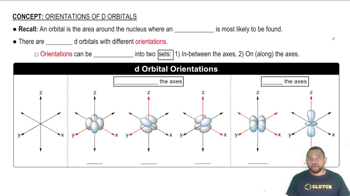
    The dxy, dyz, and dxz orbitals are oriented between the axes.
  • Which d orbitals are oriented on or along the axes?

    The dx2−y2 and dz2 orbitals are oriented on or along the axes.
  • What does the term 'orbital' refer to in chemistry?

    An orbital is the area around the nucleus where an electron is most likely to be found.
  • How is the dxy orbital oriented in space?

    The dxy orbital has its lobes positioned between the x and y axes.
  • How is the dyz orbital oriented in space?

    The dyz orbital has its lobes positioned between the y and z axes.
  • How is the dxz orbital oriented in space?

    The dxz orbital has its lobes positioned between the x and z axes.
  • How is the dx2−y2 orbital oriented in space?

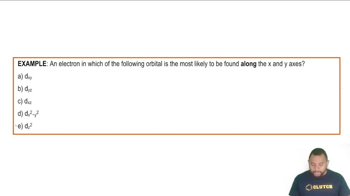
    The dx2−y2 orbital has its lobes lying directly on the x and y axes.
  • How is the dz2 orbital oriented in space?

    The dz2 orbital is aligned along the z-axis, with its lobes piercing through the nucleus.
  • Why is understanding the orientation of d orbitals important in chemistry?

    It is fundamental for understanding molecular bonding and the electronic structure of transition metals.
  • What is meant by orbitals lying 'on' or 'along' the axes?

    It means the lobes of the orbital are aligned with or directly on the x, y, or z axes.
  • What is meant by orbitals lying 'between' the axes?

    It means the lobes of the orbital are positioned in the spaces between the axes, not directly on them.
  • Which d orbital has a distinctive alignment along the z-axis?

    The dz2 orbital has a distinctive alignment along the z-axis.
  • How are the five d orbitals grouped based on their orientation?

    They are grouped into three orbitals between the axes (dxy, dyz, dxz) and two on or along the axes (dx2−y2, dz2).
  • What is the significance of the axes passing through the lobes of certain d orbitals?

    It indicates that those orbitals (dx2−y2 and dz2) are oriented directly on or along the axes, affecting their interactions in bonding.