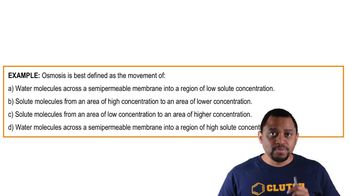
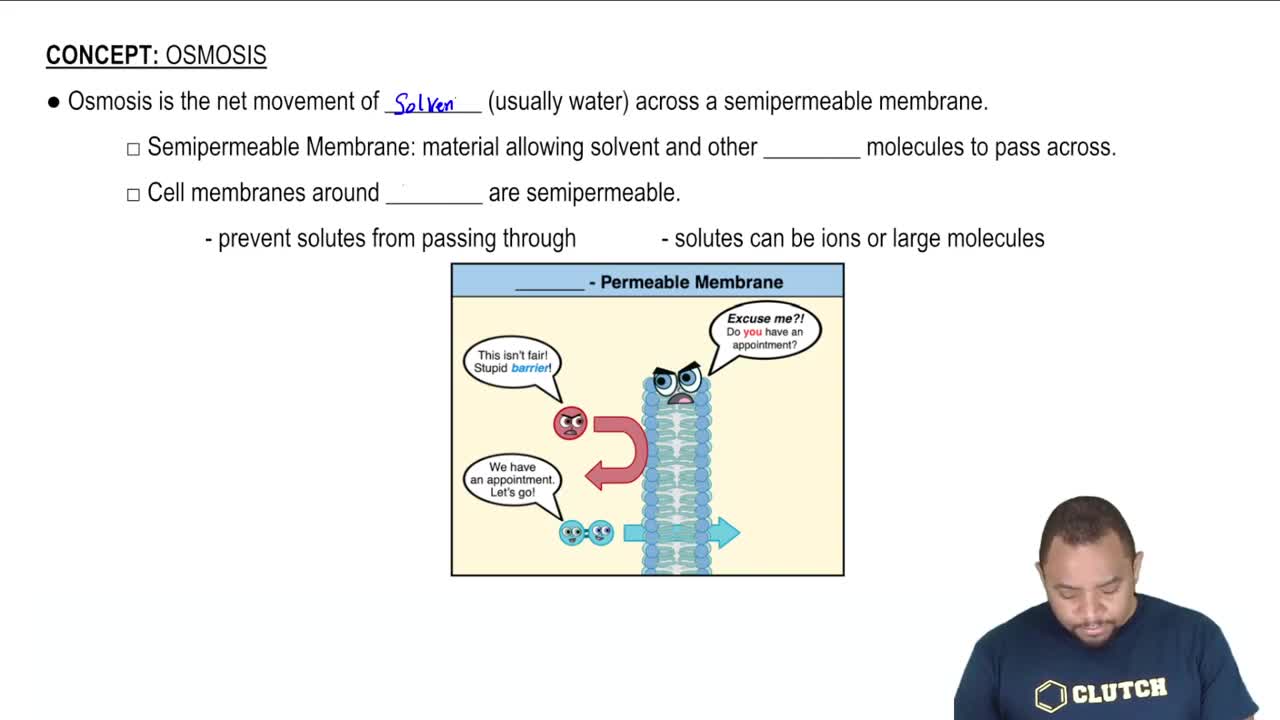
Osmosis is the net movement of a solvent, usually water, across a semipermeable membrane from a region of lower solute concentration to a region of higher solute concentration.
What is a semipermeable membrane?
A semipermeable membrane is a barrier that allows certain small molecules or solvents to pass through while blocking larger molecules or ions.
In osmosis, which direction does water move?
Water moves from the side with lower solute concentration (more solvent) to the side with higher solute concentration (less solvent).
What is osmotic pressure?
Osmotic pressure is the counterforce required to stop the flow of solvent through a semipermeable membrane.
What happens when equilibrium is reached during osmosis?
At equilibrium, the concentrations of solute on both sides of the membrane are equal, and there is no net movement of solvent.
How does the difference in solute concentration affect osmotic pressure?
The greater the difference in solute concentration across the membrane, the higher the osmotic pressure needed to stop the flow of solvent.
What is tonicity?
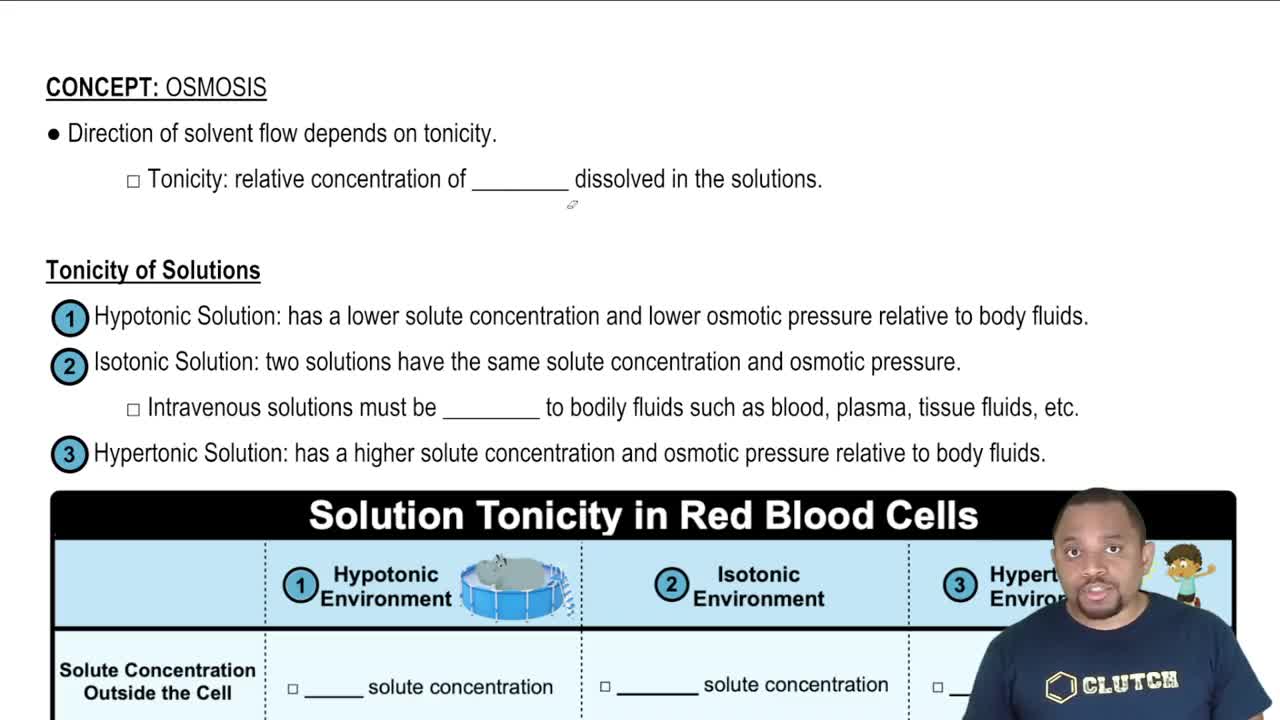
Tonicity is the relative concentration of solutes dissolved in solutions, which determines the direction of solvent flow across a membrane.
What is a hypotonic solution?
A hypotonic solution has a lower solute concentration and lower osmotic pressure compared to another solution, such as bodily fluids.
What happens to a red blood cell in a hypotonic solution?
Water enters the cell, causing it to swell and potentially burst in a process called hemolysis.
What is an isotonic solution?
An isotonic solution has equal solute concentration and osmotic pressure compared to another solution, resulting in no net movement of water.
What happens to a red blood cell in an isotonic solution?
Water enters and exits the cell at equal rates, so the cell remains stable with no net change in volume.
What is a hypertonic solution?
A hypertonic solution has a higher solute concentration and higher osmotic pressure compared to another solution, such as bodily fluids.
What happens to a red blood cell in a hypertonic solution?
Water exits the cell, causing it to dehydrate and shrink in a process called crenation.
Why must intravenous solutions be isotonic to bodily fluids?
Intravenous solutions must be isotonic to prevent cells from swelling or shrinking, ensuring that water moves in and out of cells at equal rates.
How can you remember the effects of hypotonic and hypertonic solutions on cells?
Hypotonic sounds like 'hippo,' which swells with water, while hypertonic is like a 'hyperkid' who gets dehydrated, helping you remember that cells swell in hypotonic and shrink in hypertonic solutions.
 Back
Back

 04:29
04:29