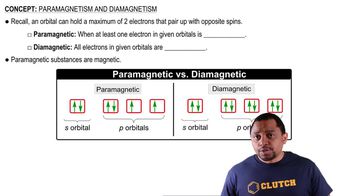
Paramagnetism and Diamagnetism quiz #1 Flashcards

Paramagnetism and Diamagnetism quiz #1
Control buttons has been changed to "navigation" mode.
1/15
  • Which of the following atoms would be expected to be diamagnetic in the ground state?
    An atom with all electrons paired in its ground-state electron configuration is diamagnetic.
  • Which of the following atoms is diamagnetic?
    An atom is diamagnetic if all its electrons are paired in its orbitals.
  • Which ion will be attracted to a magnetic field?
    An ion with at least one unpaired electron (paramagnetic) will be attracted to a magnetic field.
  • Which of the following species will be diamagnetic?
    A species with all electrons paired in its orbitals is diamagnetic.
  • Which of the following complex ions is paramagnetic?
    A complex ion with at least one unpaired electron is paramagnetic.
  • Which of the following atoms is paramagnetic?
    An atom is paramagnetic if it has at least one unpaired electron in its electron configuration.
  • Which of the following is paramagnetic?
    Any element, ion, or molecule with at least one unpaired electron is paramagnetic.
  • Which of the following elements is not paramagnetic?
    An element with all electrons paired (diamagnetic) is not paramagnetic.
  • Which of the following d shell configurations is likely to be the best magnet?
    A d shell configuration with the most unpaired electrons (e.g., d5) is likely to be the best magnet due to strong paramagnetism.
  • Fe(s) is paramagnetic. What does this mean in terms of its behavior in a magnetic field?
    Fe(s) has unpaired electrons and will be attracted to a magnetic field.
  • Is boron magnetic? Yes or no.
    Yes, boron is paramagnetic because it has unpaired electrons.
  • Is B2 paramagnetic or diamagnetic?
    B2 is paramagnetic because it has unpaired electrons in its molecular orbitals.
  • Consider the fourth period elements Ca, Mn, Co, Se, and Kr. Which of these atoms are paramagnetic?
    Mn and Co are paramagnetic because they have unpaired electrons; Ca, Se, and Kr are diamagnetic.
  • Classify these diatomic molecules as diamagnetic or paramagnetic.
    Diatomic molecules with all electrons paired are diamagnetic; those with unpaired electrons are paramagnetic.
  • Use the molecular orbital diagram shown to determine which of the following are paramagnetic.
    Species with unpaired electrons in their molecular orbital diagram are paramagnetic.