Periodic Table: Classifications quiz #3 Flashcards

Periodic Table: Classifications quiz #3
Control buttons has been changed to "navigation" mode.
1/40
  • Metalloids are located where on the periodic table?

    Along the staircase between metals and nonmetals.
  • Which is a metalloid?

    Boron (B) is a metalloid.
  • Which of the following is not a nonmetal: sulfur?

    Sulfur is a nonmetal.
  • Are the non-metal elements located on the left or right side of the periodic table?

    Nonmetals are located on the right side of the periodic table.
  • Which of the following elements is a nonmetal?

    Oxygen (O) is a nonmetal.
  • How is copper (Cu) classified based on its location on the periodic table?

    Copper is classified as a metal.
  • What type of element make up the majority of the elements?

    Metals make up the majority of elements.
  • Where on the periodic table would this element most likely be found?

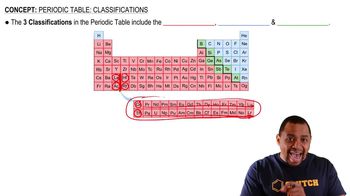
    Metals are found on the left and center, nonmetals on the right, and metalloids along the staircase.
  • How are the elements on the modern periodic table arranged?

    By increasing atomic number.
  • What defines an element’s position in the periodic table?

    An element's atomic number defines its position.
  • Is boron a metal?

    Boron is a metalloid.
  • Which of the following is a nonmetal?

    Nitrogen (N) is a nonmetal.
  • How are the elements arranged in the periodic table?

    By increasing atomic number.
  • What is Dmitri Mendeleev best known for?

    Creating the first periodic table.
  • Which element is classified as metalloid?

    Silicon (Si) is classified as a metalloid.
  • By what property did Mendeleev arrange the elements?

    By increasing atomic mass.
  • How are elements in the periodic table organized?

    By increasing atomic number and similar properties.
  • Are most of the elements on the periodic table classified as a metal or a non-metal?

    Most elements are classified as metals.
  • What are the rows and columns of the periodic table called?

    Rows are called periods; columns are called groups or families.
  • Which elements are examples of metalloids?

    Boron, silicon, germanium, arsenic, antimony, tellurium, and astatine.
  • Which of the following is a metalloid?

    Arsenic (As) is a metalloid.
  • What does the periodic table organize?

    It organizes elements by atomic number and properties.
  • Are most elements metals?

    Yes, most elements are metals.
  • What are the rows on the periodic table called?

    Periods.
  • Metalloids?

    Metalloids are elements with properties of both metals and nonmetals, found along the staircase.
  • How are the elements on the periodic table organized?

    By increasing atomic number and similar properties.
  • What are the characteristics of metalloids?

    Metalloids have properties of both metals (like conductivity) and nonmetals (like brittleness).
  • Which statement describes the location of most metalloids on the periodic table?

    Most metalloids are located along the staircase between metals and nonmetals.
  • Which of the following pairs of elements do you expect to be most similar?

    Elements in the same group, such as sodium and potassium, are most similar.
  • Which of the following elements is classified as a metal?

    Copper (Cu) is classified as a metal.
  • Which elements are located between the metals and the nonmetals on the periodic table?

    Metalloids are located between metals and nonmetals.
  • How many elements are in the lanthanides series?

    There are 15 elements in the lanthanide series.
  • Which groups on the periodic table are the most reactive?

    Group 1 (alkali metals) and Group 17 (halogens) are the most reactive.
  • Which of the following elements is a not a metal?

    Oxygen (O) is not a metal.
  • What is the difference between metals and nonmetals?

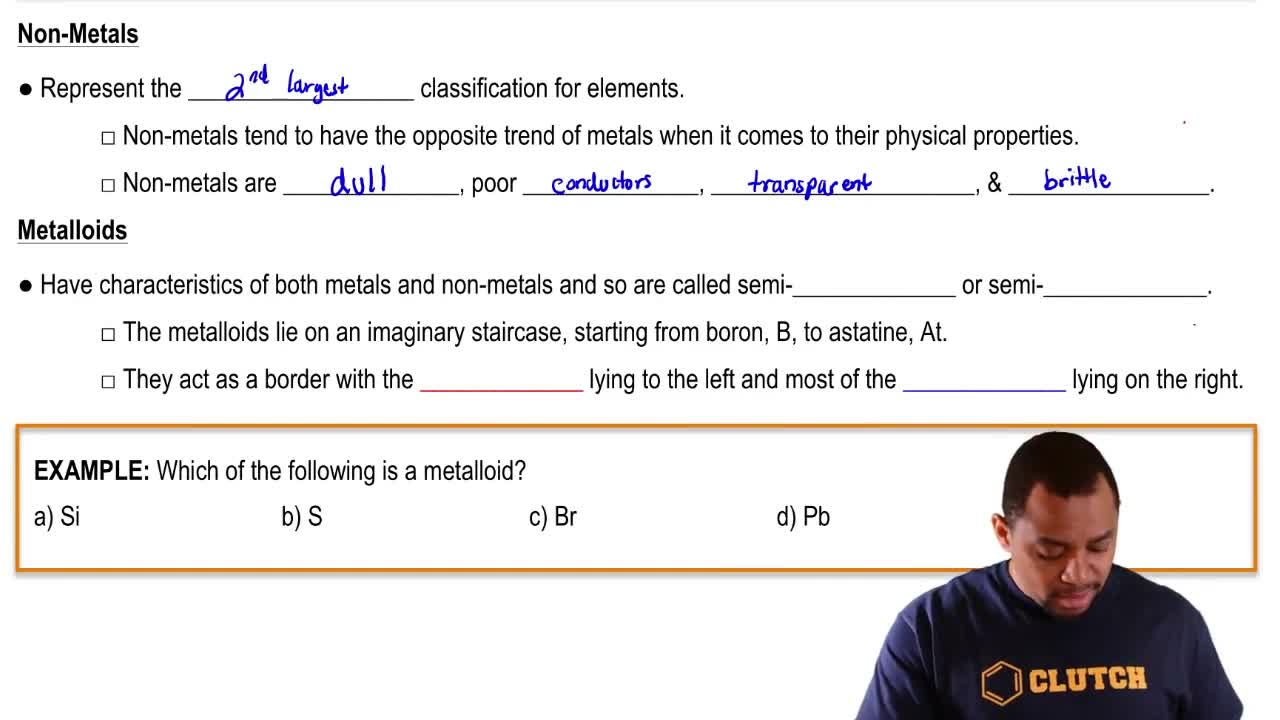
    Metals are shiny, conductive, and malleable; nonmetals are dull, poor conductors, and brittle.
  • What are metalloids? Which elements are placed in this class of elements?

    Metalloids have properties of both metals and nonmetals; examples are boron, silicon, germanium, arsenic, antimony, tellurium, and astatine.
  • What pattern did Mendeleev discover when he arranged the elements?

    He discovered that properties of elements repeated periodically when arranged by atomic mass.
  • How are elements in the modern periodic table arranged?

    By increasing atomic number.
  • How did Henry Moseley change the periodic table in 1913 to its modern form?

    He arranged elements by increasing atomic number instead of atomic mass.
  • How are elements on the periodic table organized by their properties?

    Elements with similar properties are grouped in columns (groups or families).